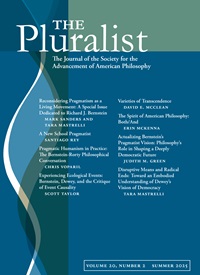
The Pluralist
DETAILS
About
Official Journal of the Society for the Advancement of American Philosophy
The Pluralist is a peer-reviewed journal dedicated to advancing the ends of philosophical thought and dialogue in all widely used philosophical methodologies, including non-Western methods and those of traditional cultures. The journal upholds the Socratic dictum of self-knowledge and the love of wisdom as the purpose of philosophy. It seeks to express philosophical insights and concerns humanely and with an eye to literary as well as philosophical excellence, but technical papers are welcome. The Pluralist is a forum for discussion of diverse philosophical standpoints and pluralism's merits. The Pluralist considers high-quality submissions on any philosophical topic written from any philosophical perspective. Articles that defend some type of pluralism, apply a pluralistic perspective to contemporary issues, or take a critical stance against pluralism are encouraged.
The Pluralist is the official journal of the Society for the Advancement of American Philosophy. In addition to research articles, The Pluralist also includes highlights from the SAAP annual meeting, Presidential addresses, Founders' addresses, and other Society-related information.

Indexes
Academic OneFile, Arts and Humanities Citation Index, Book Review Digest Plus (H.W. Wilson), Brepols, Current Abstracts, Current Contents, Humanities Abstracts (H.W. Wilson), Humanities Full Text, Humanities Index (Online), Humanities International Complete, Humanities International Index, Humanities Source, Humanities Source Ultimate, InfoTrac Custom, MLA International Bibliography, OmniFile Full Text Mega (H.W. Wilson), OmniFile Full Text Select (H.W. Wilson), Poetry & Short Story Reference Center, Scopus, The Philosopher's Index (Online), TOC Premier, Web of Science
MEMBERSHIP RATES
Click here to subscribe.
| Individuals: | 1 Year |
| Print Only | $48 |
| Online Only | $48 |
| Print + Online | $53 |
| Students: | 1 Year |
| Online Only | $20 |
| Institutions: | 1 Year |
| Print Only | $136 |
| Online Only | $142* |
| Print + Online | $159* |
| *Institutional 'Online Only' and 'Print + Online' subscriptions must be purchased through the Scholarly Publishing Collective. | |
Non-U.S. Postage: $10 Canada/Mexico, $25 Other Non-U.S. Locations
Single Issues: $30 Institutions
Back Volumes: $85 Institutions
MEMBERSHIP RATES
Become a member of the Society for the Advancement of American Philosophy. All Memberships include a subscription to The Pluralist.
| Student Member: Online Only | $20 |
| Retired Member: Online Only | $20 |
| Regular Member (income under 50k): Print + Online | $50 |
| Regular Member (income over 50k): Print + Online | $75 |
| Sustaining Member: Print + Online | $150 |
| Benefactor: Print + Online | $200 |
ONLINE + PRINT ADVERTISING

The print ad rates for all our titles can be found in the 2026 journals catalog/rate card.
Editors
Editor
Roger Ward
Philosophy Department
Georgetown College
400 East College Street
30 Pawling Hall
Georgetown, KY 40324
Roger_Ward@georgetowncollege.edu
Associate Editor
Sunny Heenen
Southern Illinois University at Carbondale
sunshine.williams@siu.edu
Book Review Editor
Seth Vannatta
Holmes Hall 309-D
Morgan State University
1700 East Cold Spring Lane
Baltimore, MD 21251
seth.vannatta@morgan.edu
College of Contributors
The Board of Directors of the Society for the Advancement of American Philosophy is the Editorial Board of The Pluralist.
- Douglas Anderson, Southern Illinois University at Carbondale
- Randall Auxier, Southern Illinois University at Carbondale
- Tom Burke, University of South Carolina
- Jacoby Adeshei Carter, Boston College
- Vincent Colapietro, Penn State University, Emeritus
- Tommy Curry, University of Edinburgh
- Steven Fesmire, Radford University
- Marilyn Fischer, University of Dayton, Emerita
- Jim Garrison, Virginia Tech, Emeritus
- Judith Green, Fordham University
- Leonard Harris, Purdue University
- Lisa Heldke, Gustavus Adolphus College
- David Hildebrand, University of Colorado Denver
- Nathan Houser, Indiana University at Indianapolis, Emeritus
- Robert Innis, University of Massachusetts Lowell, Emeritus
- Andrew Light, George Mason University
- Lee McBride, College of Wooster
- Erin McKenna, University of Oregon
- William Myers, Birmingham Southern College, Emeritus
- Greggory Papas, Texas A&M University
- Scott Pratt, University of Oregon
- Charlene Haddock Seigfried, Purdue University
- John Shook, Bowie State University
- Richard Shusterman, Florida Atlantic University
- Ken Stikkers, Southern Illinois University at Carbondale
- Brad Eliot Stone, Loyola Marymount University
- Dwayne Tunstall, Grand Valley State University
- Chris Voparil, Lynn University
- Leonard Waks, Temple University, Emeritus
In Memoriam
- Richard Bernstein
- Thelma Levine
- John J. McDermott
- Richard Robin
- Stuart Rosenbaum
- Sandra Rosenthal
- Herbert Schneider
- John E. Smith
- Bruce Wilshire
PDF Policy
Upon publication, authors will receive a link to access their article free for three months. They are permitted to share the link (not the PDF) with friends, colleagues, and on social media.
PDFs are permitted and issued for the following:
- Tenure dossier.
- Special workshops the author is moderating.
- Other requests to be evaluated on a case-by-case basis.
- All PDFs will include a statement of copyright and a provision that the articles will not be photocopied, distributed, or used for purposes other than the terms agreed to by UIP.
- University repositories; UIP requires a publication statement to be posted along with the preprint.
- Some journals have their own established policies and procedures for preprints. Please be sure to first check their respective Web sites before sending your request.
- Non-profit archives and repositories; Articles must be at least one year old. UIP requires a publication statement to be posted along with the postprint and a link back to the journal of publication's home page on the UIP website.
- Personal and commercial Web sites; Articles must be at least three years old. UIP requires a publication statement to be posted along with the postprint and a link back to the journal of publication's home page on the UIP website.
Please send all requests to:
Angela Burton
Intellectual Property Manager
UIP-RIGHTS@uillinois.edu
Submissions
The Pluralist
Submission of a manuscript to The Pluralist is understood to imply that the paper is original, it has not already been published in whole or in substantial part elsewhere, and is not currently under consideration by any other journal. Article lengths of 6,000 to 12,000 words are preferred, although longer papers will be considered. Discussion pieces, essay-length reviews, and book reviews may also be submitted. Before submitting a review, please contact Roger Ward, Editor.
A submission must omit self-identifying information to allow for double-blind review. An abstract of 100 words should be placed at the start of the paper. Citations should follow the MLA Handbook, 9th edition. No auto-formatting of notes should be used; all notes will be endnotes listed in numerical order at the end as part of the regular text. All text, including notes and extracted material (quotations, formulae), must be in 12-pt font and double-spaced. All pages must be numbered and have margins of at least one inch on all sides.
Photographs or illustrations should be numbered and sent as separate “supplementary files” in the online upload system, with the desired location clearly indicated in the main text. All photos and illustrations should be submitted as separate TIFF image files with image quality of at least 300 dpi. These should be accompanied by captions, credit lines, and secured permission(s) for reprint, and their desired location should be clearly indicated in the main text.
Articles should be submitted electronically to the Pluralist online manuscript submission system. This secure, personalized resource will allow you to track your manuscript through each step of the submission, review, and acceptance process. To begin, click below to set up your personal account and upload your submission. Your transmitted material will be reviewed as soon as possible.

Articles accepted for publication will be adjusted by editors to conform to University of Illinois Press formatting and returned to authors for proofreading. Upon publication, authors receive one copy of that issue of The Pluralist.
Featured Articles
A New School Pragmatist
Santiago Rey
https://scholarlypublishingcollective.org/uip/pluralist/article/20/2/9/400957/A-New-School-Pragmatist
Pragmatic Humanism in Practice: The Bernstein-Rorty Philosophical Conversation
Chris Voparil
https://scholarlypublishingcollective.org/uip/pluralist/article/20/2/19/400956/Pragmatic-Humanism-in-Practice-The-Bernstein-Rorty
Experiencing Ecological Events: Bernstein, Dewey, and the Critique of Event Causality
Scott Taylor
https://scholarlypublishingcollective.org/uip/pluralist/article/20/2/40/400954/Experiencing-Ecological-Events-Bernstein-Dewey-and
Qualitative Naturalism as Dewey's Ultimate Solution to the Mind-Body Problem
Andrii Leonov
https://scholarlypublishingcollective.org/uip/pluralist/article/20/3/1/403384/Qualitative-Naturalism-as-Dewey-s-Ultimate
Both Non-Commitment and Commitment Lead to Conditional Hospitality: Investigating the Impossibility of Absolute Hospitality in Albert Camus's “The Guest” and Its Cinematic Adaptation Far From Men
Hossein Mohseni
https://scholarlypublishingcollective.org/uip/pluralist/article/20/3/28/403381/Both-Non-Commitment-and-Commitment-Lead-to
The Selfhood and Temporality of the Absolute: Mary Whiton Calkins's Absolute Personalism
Michael J. Futch
https://scholarlypublishingcollective.org/uip/pluralist/article/20/3/57/403383/The-Selfhood-and-Temporality-of-the-Absolute-Mary
Actively Pursuing Positive Peace
Judith M. Green
https://scholarlypublishingcollective.org/uip/pluralist/article/21/1/1/407438/Actively-Pursuing-Positive-Peace
Mary McLeod Bethune: Women-Centered Black Activism for Social and Civil Rights
Judy D. Whipps
https://scholarlypublishingcollective.org/uip/pluralist/article/21/1/17/407447/Mary-McLeod-Bethune-Women-Centered-Black-Activism
Was Addams a Founder of Classical American Pragmatism? Or Even a Pragmatist at All?: A Call to Either Write a New, Fantastically Enlarged Account of Pragmatism's Founding, or Reduce Pragmatism to a Minor Index Entry
Marilyn Fischer
https://scholarlypublishingcollective.org/uip/pluralist/article/21/1/28/407441/Was-Addams-a-Founder-of-Classical-American