
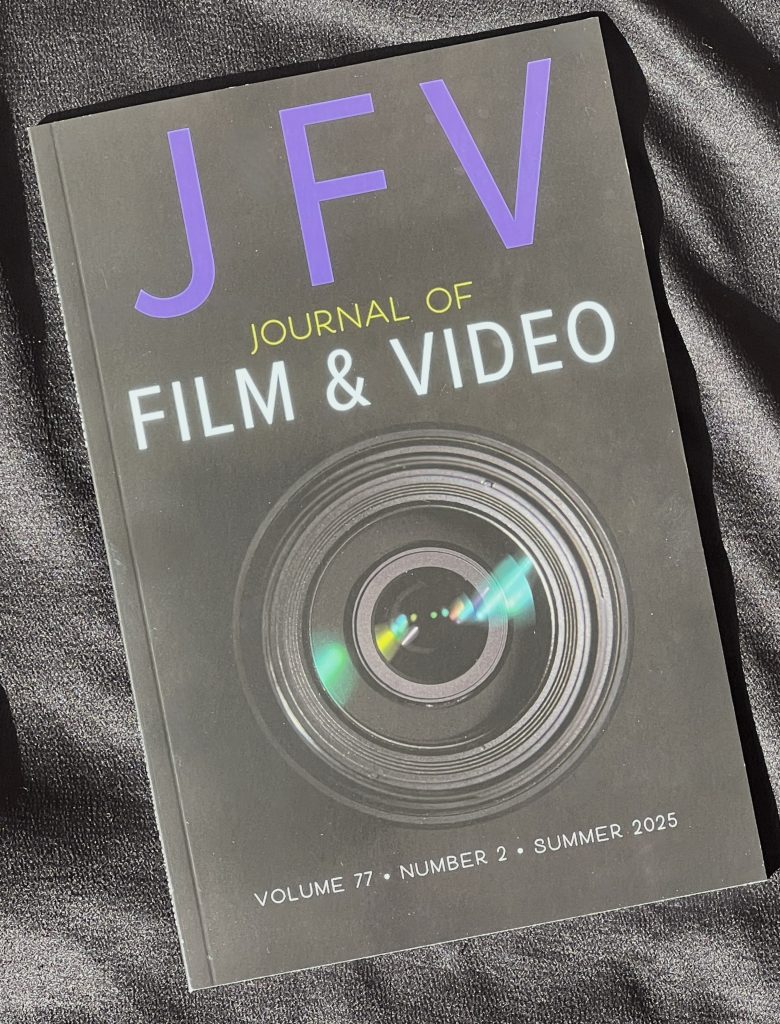
For the third year in a row, Journal of Film and Video, the official journal of the University of Film & Video Association, is releasing a reading list of recent scholarship on film and media—temporarily free to access throughout the year. Edited by Cynthia Baron, JFV is a double-blind, peer-reviewed journal published four times a year.
Read more about the articles below and mark your calendars to take advantage of the free access periods.
Recommended Reading
Free to access from July 1, 2026, to September 30, 2026:
“The Hippie, the Cowboy, and the City: Aesthetic and Political Layers in Tarantino’s Once upon a Time . . . in Hollywood” by Celestino Deleyto and David Roche
This article examines Once upon a Time . . . in Hollywood’s portrayal of both film and urban history. More specifically, Deleyto and Roche demonstrate that the film’s aesthetics and discourse are interwoven according to a series of dichotomies—city and industry, homogeneity and heterogeneity, visibility and invisibility, exclusion and inclusion, authenticity and artifice, past and present—and that these work across issues of urban and cinematic history, geography, culture, and aesthetics.
Free to access from October 1, 2026, to December 31, 2026:
“Roasting Mulan: Chinese Cultural Confidence and Tucao Video Remixes on Bilibili” by Pengnan Hu
This article illustrates Chinese audiences’ dissatisfaction with being misrepresented by foreigners by studying the inventive cultural criticism in remix videos of Disney’s live action Mulan posted on the community-based video-sharing platform Bilibili. Through analyzing the humor in these videos, Hu shows that the film’s failure in China reflects the increasing cultural confidence of Chinese audiences. Further, the roasting Mulan received on Bilibili conveys the myriad tensions in relationships between China and the United States in 2020, all increased by trade wars, the pandemic, and conflicting national security objectives.
Free to access from January 1, 2027, to March 31, 2027:
“Black Panther, The Wretched of the Earth, The Spook Who Sat by the Door, and the Endurance of Black Radical Politics” by Mary C. Schmitt
This article joins scholarship that demonstrates how Black Panther attempts to contain and demonize Black radical politics through its strategic juxtaposition of acceptable and unacceptable forms of Black activism in its characters T’Challa and N’Jadaka. Notably, N’Jadaka’s revolutionary strategy connects to the radical lineage of political theorist Frantz Fanon and novelist/filmmaker Sam Greenlee and their respective works: the 1961 text The Wretched of the Earth and the 1973 film The Spook Who Sat by the Door. An important dialogic relationship arises when one puts these works into conversation with Black Panther, as they all share parallel lessons about knowing how power operates and how to use that knowledge for the purposes of liberation.
Free to access from April 1, 2027, to June 30, 2027:
“Rewound Repression, Freaky Metamorphoses, Final Girls, and Downward Spirals: On the Rise of the Science Fiction Slasher” by Michael Burke
This article opens with a brief sketch of the slasher subgenre and the science fiction genre, identifying their basic conventions. Incorporating science fiction’s cognitive estrangement, Burke interrogates how sci-fi features are sutured to the traditional slasher film with its representation of dilated space, temporal closure, and Final Girl–Killer relationship, resulting in the science fiction slasher. Examining these characteristics in Freaky, the Happy Death Day duology, The Final Girls, and Totally Killer, the article reveals that the science fiction slasher film’s refashioning of the Final Girl–Killer relationship discloses the ongoing transformation and innovation of slasher cinema.
Find Out More
The Journal of Film and Video is a double-blind, peer-reviewed journal published four times a year. It features scholarship on film, video, and media production, history, and aesthetics as well as research on education in these fields and the role of fiction and documentary work in society. The journal is grounded in humanities research traditions that examine cultural, historical, material, and aesthetic dimensions in ways that differ from many journals in communication studies or specialty journals, such as those in cognitive studies. Yet it accepts articles that use a range of critical methods if they shed light on the production and study of film, video, and media.
- Read our blog post introducing editor Cynthia Baron.
- Check out the 2025 and 2024 JFV reading lists! Though these articles are no longer free to access, JFV subscribers can still enjoy them.
- Individual Subscriptions can be made through the University of Illinois Press website.
- To recommend this title to your library, fill out this Library Request Form.
- Ready to see your work featured in Journal of Film and Video? Submit original scholarly work here.
- You may also enjoy: Music and the Moving Image.