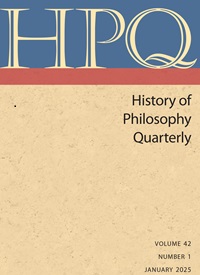
History of Philosophy Quarterly
DETAILS
About
History of Philosophy Quarterly (HPQ) specializes in papers that cultivate philosophical history with a strong interaction between contemporary and historical concerns. Contributors regard work in the history of philosophy and in philosophy itself as parts of a seamless whole, treating the work of past philosophers not only in terms of historical inquiry, but also as a means of dealing with issues of ongoing philosophical concern. The journal favors the approach to philosophical history, increasingly prominent in recent years, that refuses to see the boundary between philosophy and its history as an impassable barrier.
HPQ is published by the University of Illinois Press on behalf of North American Philosophical Publications.

Indexes
Brepols, Dietrich's Index Philosophicus, IBZ - Internationale Bibliographie der Geistes- und Sozialwissenschaftlichen Zeitschriftenliteratur, Internationale Bibliographie der Rezensionen Geistes - und Sozialwissenschaftlicher Literatur, Periodicals Index Online, Repertoire Bibliographique de la Philosophie (Online), Scopus, The Philosopher's Index
SUBSCRIPTION RATES
Click here to subscribe.
| Individuals: | 1 Year |
| Print Only | $66 |
| Institutions: | 1 Year |
| Print Only | $386 |
| Online Only | $413* |
| Print + Online | $452* |
| *Institutional 'Online Only' and 'Print + Online' subscriptions must be purchased through the Scholarly Publishing Collective. | |
Non-U.S. Postage: $10 Canada/Mexico, $35 Other Non-U.S. Locations
Single Issues: $40 Individuals, $90 Institutions
ONLINE + PRINT ADVERTISING

The print ad rates for all our titles can be found in the 2026 journals catalog/rate card.
Editors
Editor
James Petrik
Philosophy Dept
Ohio University
Athens, OH 45701
petrik@ohio.edu
Consultants
- Professor Maria Rosa Antognazza, Kings College, London
- Professor Margaret Atherson, University of Milwaukee, Wisconsin
- Professor Sarah Broadie, University of St. Andrew
- Professor Margaret Cameron, University of Victoria
- Professor Roger Crisp, St. Anne’s College
- Professor Patricia Curd, Purdue University
- Professor Cynthia A. Freeland, The University of Houston
- Professor Don Garrett, New York University
- Professor Lenn Goodman, Vanderbilt University
- Professor Paul Guyer, Brown University
- Professor Edward Halper, The University of Georgia
- Professor Rachana Kamtekar, University of Arizona
- Professor Paul Katsafanas, Boston University
- Professor Morgens Laerke
- Marcy Lascano, University of Kansas
- Professor Beatrice Longuenesse, New York University
- Professor Nadia Maftouni, University of Tehran
- Dr. Anna Marmodoro, Corpus Christi College
- Professor Fred D. Miller, Jr., Bowling Green University
- Professor Nicholas J. Moutafakis, Cleveland State University
- Professor Robert Pasnau, University of Colorado
- Dominik Perler, Humboldt University of Berlin
- Professor John Richardson, New York University
- Professor Mark Roberts, Franciscan University of Steubenville
- Professor Andrea Robiglio, Katholieke Universiteit Leuven
- Professor Peter Simpson, The Graduate Center, CUNY
- Professor Eleonore Stump, St. Louis University
- Professor Steven Sverdlik, Southern Methodist University
- Professor Thomas Williams, University of Southern Florida
- Professor Kenneth Winkler, Yale University
PDF Policy
Upon publication, authors will receive a link to access their article free for three months. They are permitted to share the link (not the PDF) with friends, colleagues, and on social media.
Pre-Publication Policy
The History of Philosophy Quarterly will not publish material that has already appeared elsewhere. This is not at odds with authors sharing their papers with selected individuals whose comments they would welcome or who they wish for other reasons to inform about their work. But it precludes pre-publication with broadcast dissemination, alike in print or electronically in open-access forums such as Academia.edu.
PDF Post-Print Policy
PDFs are permitted and issued for the following:
- Tenure dossier.
- Special workshops the author is moderating.
- Other requests to be evaluated on a case-by-case basis.
All PDFs will include a statement of copyright and a provision that the articles will not be photocopied, distributed, or used for purposes other than the terms agreed to by UIP.
Postprints are permitted for:
- Non-profit archives and repositories; Articles must be at least one year old. UIP requires a publication statement to be posted along with the postprint and a link back to the UIP Journals page.
- Personal Web sites; Articles must be at least one year old; commercial web sites: articles must be at least three years old. UIP requires a publication statement to be posted along with the postprint and a link back to the UIP Journals page.
Please contact the Intellectual Property Manager for more information.
Please send all requests to:
Angela Burton
Intellectual Property Manager
UIP-RIGHTS@uillinois.edu
Submissions
Please verify that all communications come from the editor directly (see “Editors” for contact information) or from Scholastica, our submission system. There is no cost to submit or publish in the journal unless you have requested open access for your accepted article.
Contributions may be as short as 3,000 words or as long as 8,500 including endnotes and bibliography. All manuscripts should be composed with proper pagination, wide margins, and double spacing between lines. Endnotes should be used sparingly and should be numbered consecutively, typed with wide margins and double spacing, placed at the end of the paper. Authors should follow Chicago Manual of Style (17th ed.). A brief abstract and a list of key words should be included at the beginning of the article. Please follow the style described in the style sheet HPQ Style Sheet.
Articles should be submitted electronically to the HPQ online manuscript submission system. This secure, personalized resource will allow you to track your manuscript through each step of the review and acceptance process. To begin, click on the link below to set up your personal account and upload your submission. Your transmitted material will be reviewed as soon as possible.

Scholastica account set-up help
Evaluation Procedures
While some submissions are declined upon initial internal review by the editor as inappropriate, improperly prepared, too long, too weak, etc., the great majority of submissions are sent blind to two philosophers expert in the area of the topic. Reports on submitted articles are provided by members of the HPQ Board of Consults and also by a very large array of expert scholars from across the world who are not directly connected with the journal's editorial management. Reviews are always anonymous and the choice of evaluators is solely dependent on area of expertise. In order to expedite getting decisions to authors, in rare cases the editor might make a decision on the basis of one reviewer when their review is particularly thorough and authoritative.
The evaluators are asked to supply a recommendation of accept, decline, revise & resubmit, etc., and comments. They frequently respond with generous reports containing detailed critical comments and suggestions for authors. The varying multi-step process of arranging for expert readers, evaluation, revision, reconsideration, and final revision can take six or more months. The current acceptance rate is ca. 10% and declining due to an increase of highly competitive submissions.
Style Sheet
Please read the Style Sheet and follow the guidelines when writing a paper for this journal.
View our Publications Ethics and Malpractice Statement
Featured Articles
Conceptual Enlightenment: Reading the Encyclopédie as Moral Epistemology
Jörg Noller
https://scholarlypublishingcollective.org/uip/hpq/article/42/3/205/404323/Conceptual-EnlightenmentReading-the-Encyclopedie
Adorno on Modesty as a Virtue
Tom Whyman
https://scholarlypublishingcollective.org/uip/hpq/article/42/3/225/404321/Adorno-on-Modesty-as-a-Virtue
The Authority of Scripture
Nathan Rockwood
https://scholarlypublishingcollective.org/uip/hpq/article/42/3/247/404324/The-Authority-of-Scripture
Émilie Du Châtelet's Account of Knowledge
Clara Carus
https://scholarlypublishingcollective.org/uip/hpq/article/42/3/267/404320/Emilie-Du-Chatelet-s-Account-of-Knowledge
Class is the Measure: Georg Lukács and A Materialist Reading of the Presocratics
Osman Nemli
https://scholarlypublishingcollective.org/uip/hpq/article/42/3/287/404322/Class-is-the-MeasureGeorg-Lukacs-and-A-Materialist
Reading The Mark of The Mark, or “The False Subtlety of the Four Syllogistic Figures”
Daniel Heller-Roazen
https://scholarlypublishingcollective.org/uip/hpq/article/42/4/315/408904/Reading-The-Mark-of-The-Mark-or-The-False-Subtlety
In the Realm of Shades: Obscure Representations in Dreams of a Spirit-Seer
Francey Russell
https://scholarlypublishingcollective.org/uip/hpq/article/42/4/329/408899/In-the-Realm-of-ShadesObscure-Representations-in
Kant's Physical Monadology: Why the First Marriage of Geometry and Metaphysics Didn't Work Out
James Messina
https://scholarlypublishingcollective.org/uip/hpq/article/42/4/345/408901/Kant-s-Physical-MonadologyWhy-the-First-Marriage
A Sentimentalist Deontology? Smith on Normative Ethics
Massimo Reichlin
https://scholarlypublishingcollective.org/uip/hpq/article/43/1/1/411409/A-Sentimentalist-Deontology-Smith-on-Normative
Possibility, Actuality, and Determinacy: Baumgarten's Metaphysics of Contingent Existents
Mario Schärli
https://scholarlypublishingcollective.org/uip/hpq/article/43/1/27/411412/Possibility-Actuality-and-DeterminacyBaumgarten-s
Being as Common in Plato's Theaetetus
Colin C. Smith
https://scholarlypublishingcollective.org/uip/hpq/article/43/1/53/411411/Being-as-Common-in-Plato-s-Theaetetus