
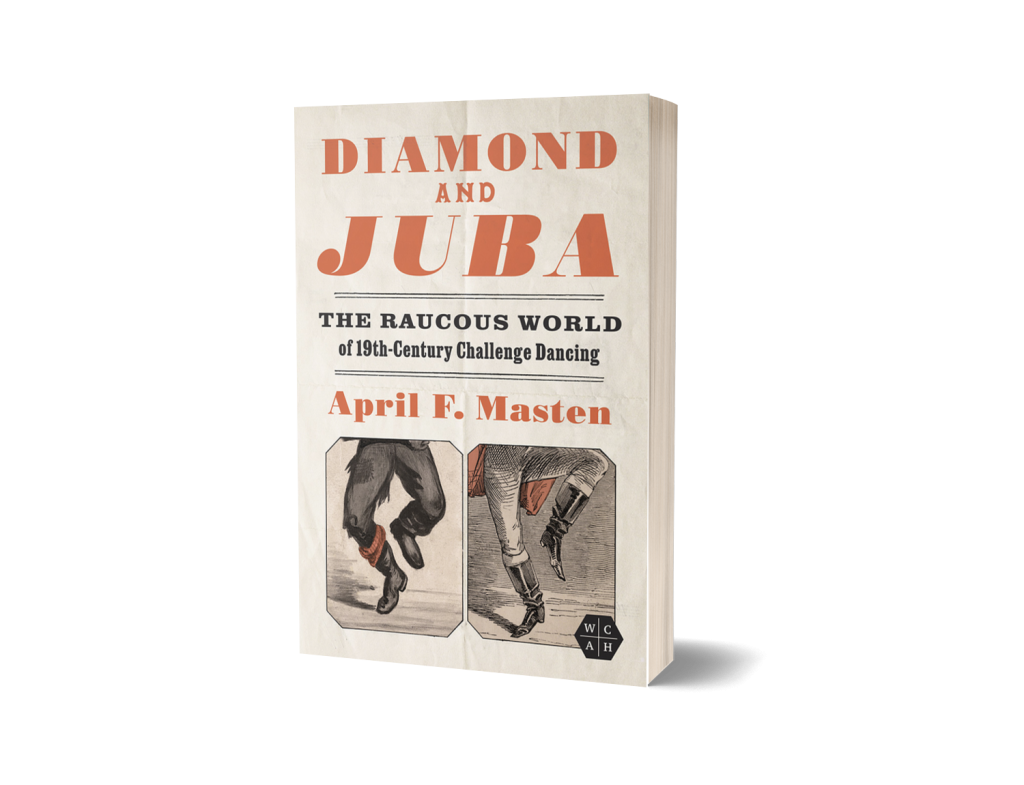
April F. Masten, author of Diamond and Juba: The Raucous World of 19th-Century Challenge Dancing, answers questions about her new book.
Q: Why did you decide to write this book?
After publishing my first book on visual artists, I wanted to branch out to a new and exciting topic. I had heard about the African American dancer known as Juba and his “Grand Public Contest” with the Irish American dancer John Diamond, but I could find no information on Diamond. My decision to research challenge dancing was cemented after two events: I reread the description of Juba’s dancing in Charles Dickens’s “American Notes” and realized he was competing with his female partner in an African American version of an Irish set-dance. And I went to a performance of Riverdance while living in Virginia and saw Colin Dunn’s composition “Trading Taps,” which imagines the meeting of Black and Irish dancers on the streets of New York. I knew then I had to find out what really happened.
Q: What is the most interesting discovery you made while researching and writing your book?
So many things surprised and delighted me: young male jig dancers borrowing steps from ballet dancers; challenge dancing’s connection to boxing; all the child performers; the wretchedness of circus travel; all the impersonators; Diamond’s enlistment in the Mexican War; Juba’s reception in the British Isles; Diamond’s arrests and incarceration. The list goes on!
Q: What myths do you hope your book will dispel or what do you hope your book will help readers unlearn?
1. That race riots, job competition, and minstrelsy’s racist stereotyping characterized the totality of relationships between Black and Irish men in the antebellum era. Poor Irish immigrants have been blamed for all kinds of racist and violent acts that were actually perpetrated by native-born whites.
2. That female jig dancers were just copying the men when they engaged in dancing matches. Challenge dancing emerged from male-female competitions at the end of set-dances. And while they risked being labeled prostitutes by middle-class spectators, professional jig dancers like Julia Morgan and Kate Stanton publicly challenged both men and women to dance matches for high stakes.
3. The idea that dancing was never considered an actual sport. Jig dancing matches were taken as seriously as boxing matches in the mid-nineteenth century.
Q: Which part of the publishing process did you find the most interesting?
Researching and writing the book.
Q: What is your advice to scholars/authors who want to take on a similar project?
Resist the urge to be done. Don’t skimp on the research. Go wherever your sources lead you. Don’t assume you know already what a word or a dance or another form of culture meant to people at that time. Go back to the sources and find out. Write clearly so that anyone can understand what you are saying. Then rewrite your prose until you are pleased with it. Keep in mind that history is both story and analysis.
Q: What do you like to read/watch/or listen to for fun?
I like to read books about writing, novels (mostly by Irish and English authors), and good sci-fi fantasy.
I like to listen to all sorts of contemporary music performed by songwriters and bands playing in lots of different genres.
I like to dance.

April F. Masten is a professor of American history at the State University of New York at Stony Brook. She is the author of Art Work: Women Artists and Democracy in Mid-Nineteenth Century New York.