
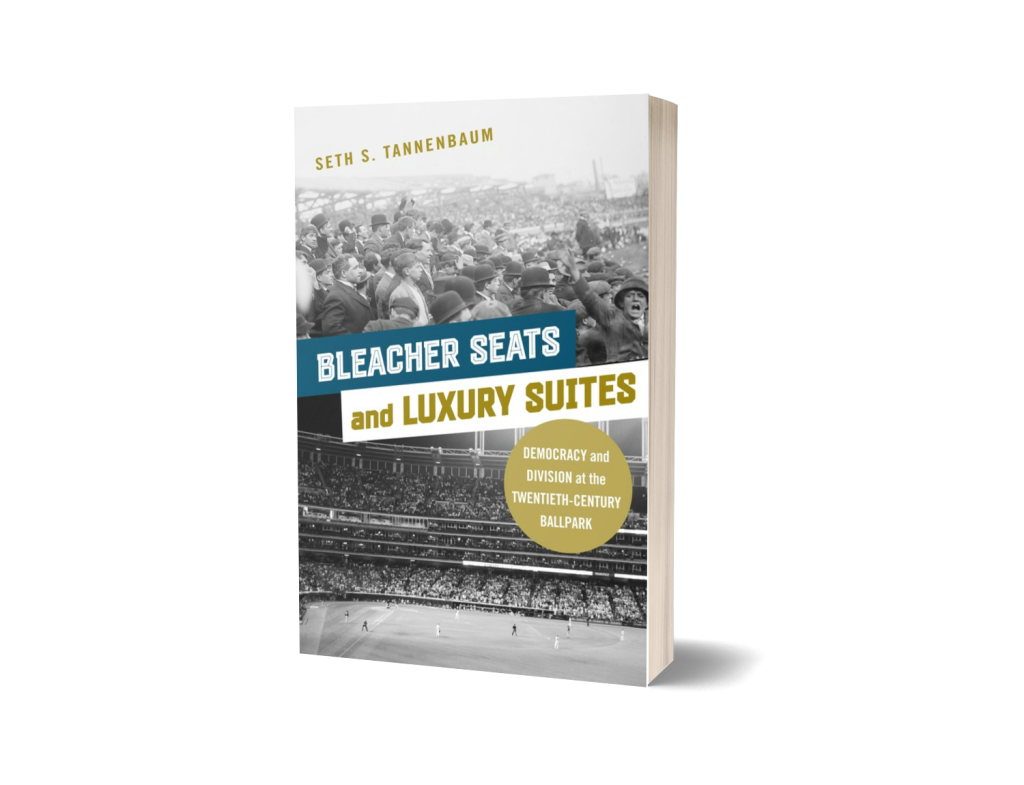
Seth S. Tannenbaum, author of Bleacher Seats and Luxury Suites: Democracy and Division at the Twentieth-Century Ballpark, answers questions about his new book.
Why did you decide to write this book?
In graduate school, I took classes on consumer culture history and food history and began to think about the nexus of the two. I soon realized that they coalesced in many ways in the fan experience at baseball games. As a lifelong baseball fan, I was intrigued by the topic enough to know that it was something I could “live with” (and not get tired of) for the length time it would take to research and write the book. More importantly, however, I realized it was a very important topic that helped to explain the nature of American society and one that had not been appropriately addressed by other scholars.
What is the most interesting discovery you made while researching and writing your book?
The role of the baseball fan experience in the long Civil Rights Movement was most interesting to me. From Black elites (including journalists and clergy) urging Black fans to “behave better” at Negro League games played in major league ballparks so that white MLB owners would be more likely to integrate their teams to Black activists pushing for an integrated Astrodome to propel the desegregation of public spaces in Houston, the fan experience was part of one of the most important social and legal changes in the twentieth century.
What myths do you hope your book will dispel or what do you hope your book will help readers unlearn?
I hope it dispels the notion that MLB games ever were a site of equality and democratic accessibility. From the outset, there were restrictions that limited the ability of women, poorer people, and people of color to fully participate in the experience. While those limits and the format of the restrictions to access have changed over time, the notion that there was any point in MLB history in which the games were truly democratic spaces is bunk.
Which part of the publishing process did you find the most interesting?
Because this question is coming from my publisher, it almost feels like a trap, and I should respond with “everything!” I did really enjoy going through public domain photographs to find images to use in the book—some really are worth a thousand words in that they succinctly illuminate points I make in the text. I also enjoyed the copy-editing process because I can be a bit of a grammar nerd and it was interesting to talk about the fine points of grammatical choices with my copy editor.
What is your advice to scholars/authors who want to take on a similar project?
Make sure you are engaging with the scholarship that is already out there connecting sport to other elements of American history but also connecting with the scholars themselves—both those who have already published on the topic and those that are working on it. Find and attend (if possible) conferences where these folks are presenting and get your ideas and research out there for constructive feedback and encouragement.
What do you like to read/watch/or listen to for fun?
I watch a lot of the Philadelphia Phillies, to my enjoyment and often my detriment. I also watch some soccer, particularly the Philadelphia Union and the US Women’s National Team. I enjoy playing ultimate and I’ll go on runs from time to time. When I’m in need of a relaxing watch, I find episodes of the BBC’s Repair Shop. Watching broken things that are important to people get fixed in a loving and caring manner soothes my soul.

Seth S. Tannenbaum is an assistant professor of sport studies at Manhattanville University.