
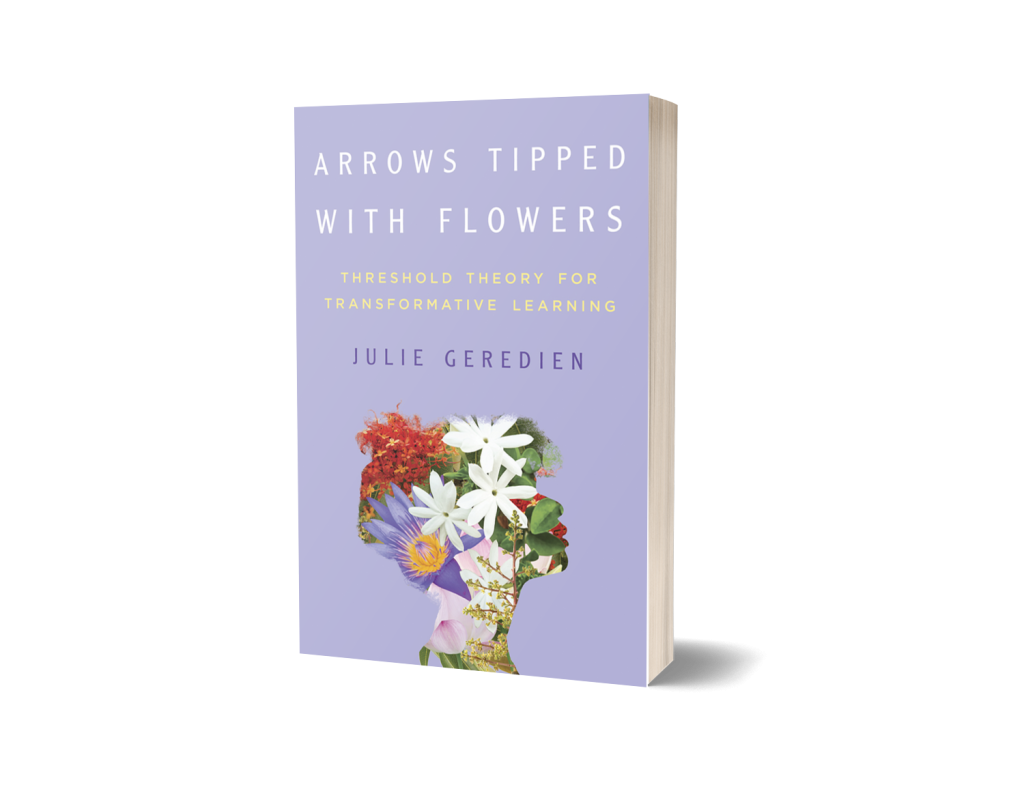
Julie Geredien, author of Arrows Tipped with Flowers: Threshold Theory for Transformative Learning, answers questions about her new book.
Q: Why did you decide to write this book?
Although much of my early training and professional background is in the performing arts and mind-body practices, in my thirties I became dedicated to teaching children in public school settings, and initiating activities outside of school, in community centers. I loved the honesty of children’s natural responses to life, and the overall community spirit, including the service ethic. Perhaps because of my prior work, as an educator, I became preoccupied with ethical and aesthetic questions related to motivation, the medicating of young people, and integrity to process. So alongside out-of-school projects, like designing learning spaces with youth, I began independently inquiring into the biology of learning and social justice issues, like what is involved in the comprehension process? How do people in different cultures support mental health within and through community? Could respect for Nature and critical insight into humanism provide a way to address structural violence—problems related to the standardization of learning and our nation’s unaddressed social, political and economic histories? This research affirmed the existence of a multi-layered “universal” reality relevant to our biological and spiritual well-being. If articulated in terms of post-colonial vision, with adequate cultural and historical particularity, this excluded or denied “universality” could reorganize how our daily practices and social structures support human development. It is unfortunate yet true that many people who pride themselves on their professionalism in education and other fields that pertain to public welfare do not have enough familiarity with world philosophies (or Indigenous ecological premises) to think critically about, or outside of, “Enlightenment era rationality.” Rather than offering additional various forms of social criticism to raise awareness, I wondered if I could help relink people to ancient standards, like kinship, that exist outside of human-constructed agendas for success. What could poets, musicians, creation stories, theatrical performances, and Sacred Writings teach us about decolonizing knowledge formation; and how could the perspectives of eco-feminists, religious and Indigenous philosophers, and neurobiologists working in the field of moral development help to create a framework for talking about those findings? Writing Arrows Tipped with Flowers ultimately was a way to introduce into sometimes narrow conversations about human development, the significance of a non-reified relationship to the life drives. Futuristic womanist visions, like Layli Maparyan’s understanding of self-governance and “rule by Light,” help us to relate search and yearning to eros and to Sophia as Wisdom so that we can address the normative structural requirements of the human spirit. Indigenous or “living” standards, like kinship, and concepts like the threshold—found in religion, ecology, and higher education—point to possibilities beyond the limits imposed on imagination and reason by the race-reproduction bind. Committing to a post-oppositional approach, that is, to a long-term vision for sustainable, deep structural change, made it possible to work on this book for the significant length of time that it required.
Q: What is the most interesting discovery you made while researching and writing your book?
This project involved a lot of interesting connection-making. For example, in my analyses of Kamala Das’s poetry, I was intrigued by the possible ways that imagery and themes from the Mahabharata may have influenced her, and what this said about our relationship to primordiality. Likewise, when studying the dynamics of concealment and ecstasy in jazz and Black performance, it was fascinating to realize how these realities might be akin to the relational dynamics of elements in traditional Chinese medicine. Although it is hard to say what the “most interesting” discovery was, it was quite exciting to recognize the analogous structures across different cultural theories of mind and place-based approaches to balancing resilience, joy, and steadiness. Identifying how the Sophianic functions described in this book could complement these theories and help us work across cultures to protect and promote the mind’s capacity for dynamic equilibrium was very meaningful. I hope activists involved in decolonizing mental health care will engage with this finding!
Q: What myths do you hope your book will dispel or what do you hope your book will help readers unlearn?
I hope readers will be dissuaded from the belief that theological, eco-spiritual, and moral ideas should be relegated to the private sphere alone. Insights and questions from these domains do have a place in public discourse and in scholarly investigations. The U.S. history of secularism which is aligned with the goals and methodologies of scientific rationalism and thus with anti-black violence and various forms of oppression has cut people off from this perspective. I hope readers will perceive how crucial those ideas are for a robust deliberative life because of the emphasis they place on the subject’s capacity for transformation, and the wisdom they provide regarding how humans can uproot prejudices, navigate ethical dilemmas, and respond to ultimate life concerns. Additionally, in line with Kelli Zaytoun’s aims in writing Shapeshifting Subjects: Gloria Anzaldúa’s Naguala and Border Arte, I hope readers who are conditioned to view art as something in “another world,” removed from social issues and concerns, and only relevant to a select few, may realize that art has a major role to play in learning and in knowledge formation processes. In performative and expressive acts, intent is always active, and ways of knowing through representational logic alone, dissolve. Because it pertains both to the mystical and political, art can open us to the poetic dimensions of community life and reveal to us the nature or “texture” of freedom.
Q: Which part of the publishing process did you find the most interesting?
Interacting with the copy editor about technical questions very educational. I also appreciated seeing how the book’s contents, including graphics and images, were formatted and laid out in the final proof copy, for example. The most “interesting” part, in the sense of “thought-provoking,” was the process of revising the manuscript at the sentence level, to develop better transition sentences between paragraphs, for instance, because I could then reconsider the significance of certain findings from an often-unexpected perspective and imagine how different readers might experience the text.
Q: What is your advice to scholars/authors who want to take on a similar project?
At certain junctures, like at the end of an initial generative period of writing and research, this project felt quite chaotic and I wasn’t sure how it would gain the coherence necessary to be a book. At least one person who looked over the writing early on thought it was a mess! But in the end, I didn’t opt to narrow my topic or remove major threads that run through it, although of course I still edited out a lot of content. So, my advice is, if you want to introduce a more comprehensive perspective—to engage critically with a wider variety of relevant ideas and terms across fields—then stay with your desire to do so, and don’t worry if at times it seems like it is an impossible task. It isn’t. In my experience it is just a longer task and asks you to stay with it despite doubts. Keep approaching the work in new ways and pursuing more nuanced understandings. You will grow and adapt to the challenges that arise as your project grows and changes. Your writing will inform you and you will inform it.
Q: What do you like to read/watch/or listen to for fun?
I love watching dance performances, and even though I am not currently attending many live performances, there is so much amazing creative work available to watch on YouTube, like “The Spider” performed by Milena Sidorova, or Janelle Monáe’s “Tightrope” featuring Big Boi.
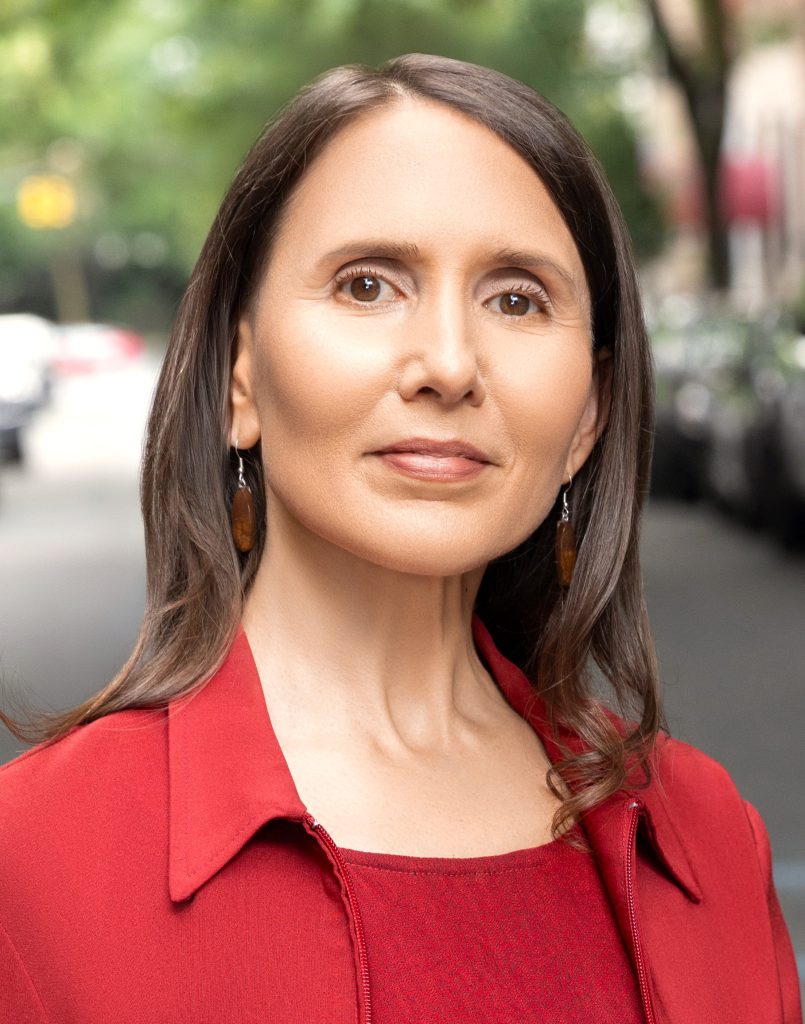
Julie Geredien is an independent scholar, educator, and performing artist.