
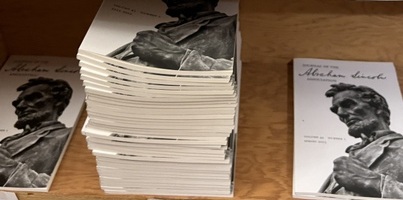
Have you been considering submitting your work to the Journal of the Abraham Lincoln Association? Incoming editor Christian McWhirter has prepared the perfect reading list to inspire you in your own work. But first, allow us to introduce you to Dr. McWhirter and the Journal.
The Journal of the Abraham Lincoln Association is the only peer-reviewed academic journal exclusively dedicated to Abraham Lincoln scholarship. As the official journal of the Abraham Lincoln Association, JALA publishes cutting-edge research, newly discovered primary sources, and thought-provoking analyses of Lincoln’s life, legacy, and the historical context in which he lived.
Meet the Editor

Christian McWhirter, who previously edited Journal of the Abraham Lincoln Association from 2013 to 2018, is making his return with the Fall 2026 issue of the Journal (Volume 47, Issue 2). McWhirter was previously Lincoln Historian at the Abraham Lincoln Presidential Library and Museum and an assistant editor for The Papers of Abraham Lincoln. He’s also the author of Battle Hymns: The Power and Popularity of Music in the Civil War (2012). He received his PhD in American History from the University of Alabama.
“It’s truly an honor to once again helm the leading publication for Lincoln scholarship,” says McWhirter. “The lessons of Lincoln’s life, leadership, and legacy are more important now than ever, and it’s a privilege to help scholars from all over the world research and tell those stories.”
Ready to Submit?
The Journal of the Abraham Lincoln Association welcomes manuscript submissions on any aspect of Lincoln’s life, his family, his close associates, or his legacy. We encourage research that examines the historical, social, and cultural context of Lincoln’s time; the evolution of Lincoln’s reputation over time; and unpublished primary source materials related to Lincoln.
Learn more and submit on our website.
Recommended Reading
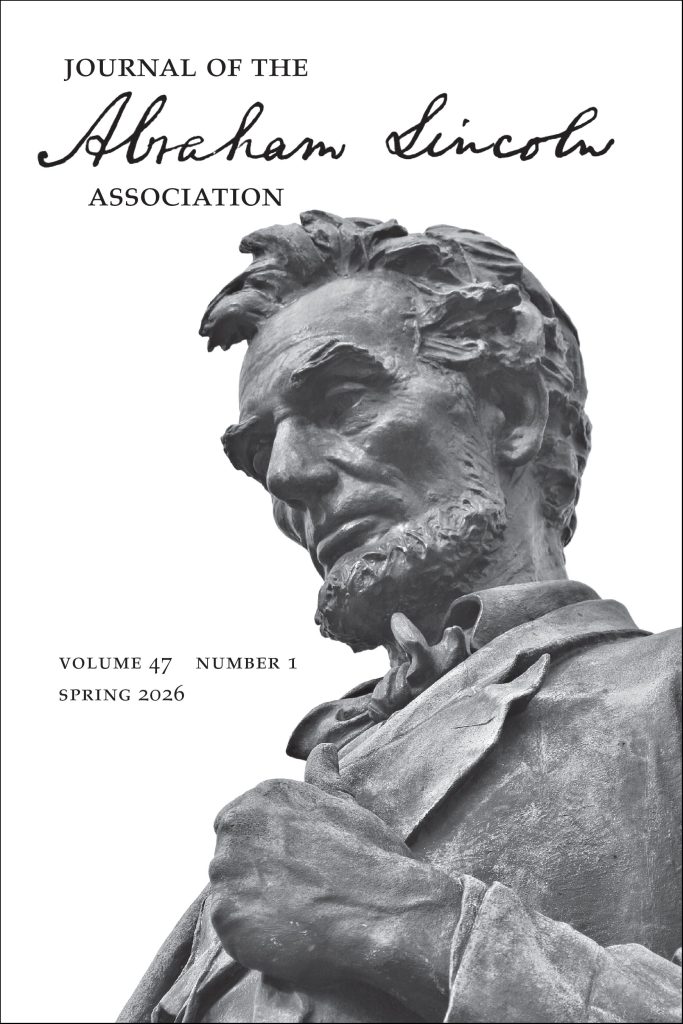
Did you know that Journal of the Abraham Lincoln Association is open access? Six months after the new issues release, you can read all of the content for free online on the Scholarly Publishing Collective. But, if you want to get your hands on the all the new scholarship earlier, in print, you can become a member of the Abraham Lincoln Association. Or, you can recommend that your local or institutional library become a member.
Here’s a peek at some of the great content available in the journal, a selected reading list by incoming editor Christian McWhirter.
- “On Lincoln’s ‘Instrumentality’ to End Slavery: Meditation on the Divine Will and the Emancipation Proclamation” by John A. O’brien (Vol. 45, No. 1)
On November 17, 1903, Secretary of State John Hay addressed a meeting at the New York Avenue Presbyterian Church in Washington, D.C., by reading a note that he found among the papers in Lincoln’s desk after the president’s death. He gave it the title “Meditation on the Divine Will” and made it public in 1872 to refute William Herndon’s depiction of Lincoln as a religious skeptic. Hay speculated that the Meditation was written near the end of September 1862. He reasoned that the note reflected Lincoln’s anxiety over recent battle losses and pressures over issuing the preliminary Emancipation Proclamation.
- “‘Home Is the Martyr’: The Burial of Abraham Lincoln and the Fate of Illinois’s Capital” by Jeremy Prichard (Vol. 38, No. 1)
Despite the widespread fascination surrounding Abraham Lincoln’s death, many questions linger regarding the process and motivations of his burial in Springfield. Among those are the following: Why did the community, only half of which approved of his presidency, rally behind the city’s efforts to bring his remains home for interment? Why, after promised his bones, were local leaders and residents initially insistent on laying Lincoln’s body near the city’s center and raising a monument over it? And why, after the funeral, did Mary Lincoln continue to threaten removal of her dead husband’s corpse outside the region, forcing the community to accept Oak Ridge Cemetery as Abraham Lincoln’s final resting place?
- “‘The Spirit Which You Have Aided to Infuse’: A. Lincoln, Little Mac, Fighting Joe, and the Question of Accountability in Union Command Relations” by Ethan S. Rafuse (Vol. 38, No. 2)
In January 1863, Abraham Lincoln wrote a letter to Major General Joseph Hooker on the latter’s assumption of command that month. In the letter Lincoln famously addressed rumors that Hooker had called for a dictator in order to place Union civil-military relations, badly warped in the months that preceded Hooker’s ascension to command, on a more proper footing. Lincoln also decided to address a significant problem that had plagued the Army of the Potomac during and after George B. McClellan’s time in command.
- “The Mystery of Rome’s Tribute to Abrahamo Lincolnio” by Don H. Doyle (Vol. 46, No. 2)
Millions of tourists who visit Lincoln’s tomb in Springfield, Illinois, pass by an ancient stone tablet bearing a Latin inscription. It is installed at the foot of the obelisk that rises above the slain president’s crypt. Directly below the tablet is an English translation. The Latin inscription on the stone is accurately translated, and the details about its origin and passage from Rome to Springfield are mostly correct. The questions left unanswered have compelled Doyle to write this essay.