
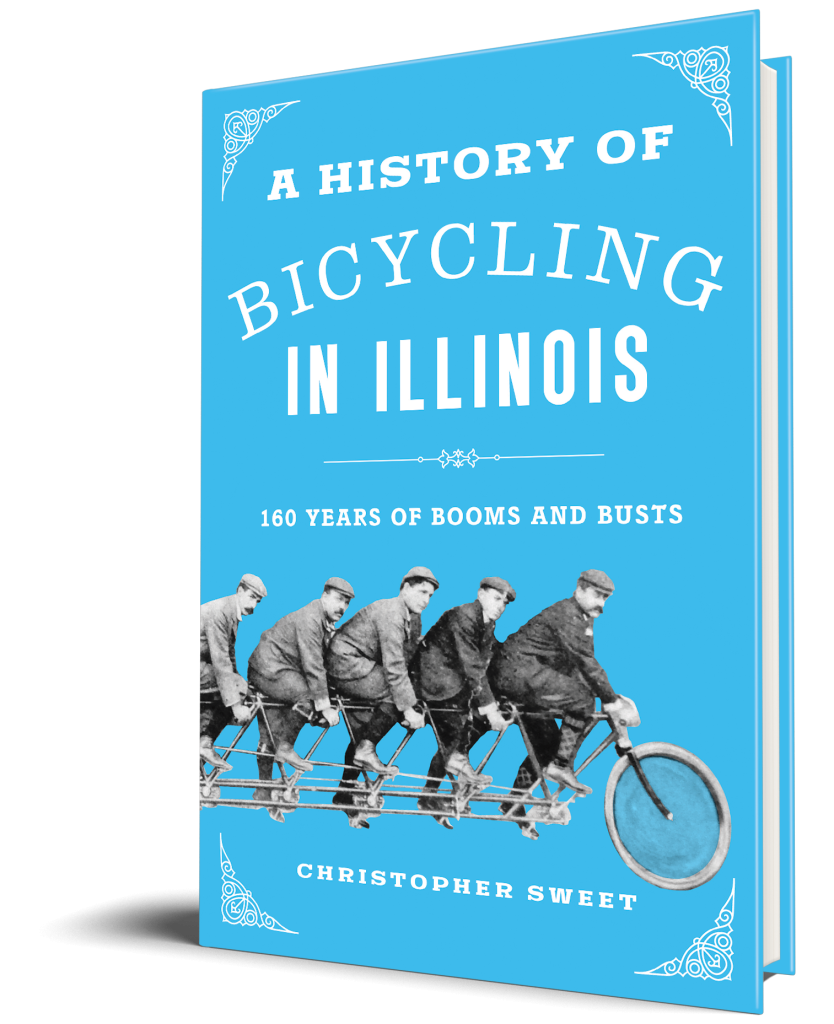
Christopher Sweet, author of A History of Bicycling in Illinois: 160 Years of Booms and Busts, answers questions about his new book.
Q: Why did you decide to write this book?
I’ve worked as a librarian for the last twenty years, but my background is in English and History. Writing a book fulfills a lifelong librarian goal, but it was also a return to my educational roots. As I uncovered more of the early history of bicycling in Illinois, I felt compelled to honor the stories of some amazing Illinois bicycle characters and events.
Q: What is the most interesting discovery you made while researching and writing your book?
It took me many years of researching and writing before I began to assemble the pieces of an argument about how bicycles contributed to a more equitable and egalitarian society. Nineteenth century cyclists were predominantly middle- and upper-class white males, yet they fervently believed that bicycling was a great leveler that would lead to a more democratic society. The bicycle utopia they envisioned, however, excluded women, Black Americans, and immigrants. It wasn’t until the late twentieth century through today, that this vision of bicycles contributing to a more just and equitable society became a more of a reality.
Q: What myths do you hope your book will dispel or what do you hope your book will help readers unlearn?
Bicycle historians (there are such a thing) have traditionally focused on the New England states as the early centers of American bicycling. This book challenges those arguments through meticulously researched quantitative and qualitative evidence — over 1,500 citations! This book also challenges a broader and more significant myth about the role of bicycles in American life and culture. As this book argues, bicycling and bicyclists played a significant role during a formative period of American history. Specifically, bicycling contributed far more to the goals of the Progressive Movement (1890-1920) than has been previously recognized. Bicycling paved the way for greater independence for women through advancing suffrage, dress reform, temperance, and bodily autonomy.
Q: Which part of the publishing process did you find the most interesting?
After completing my first draft of this book I had an opportunity to work with another accomplished historian who provided extensive developmental editing feedback on my manuscript. This invaluable feedback helped to focus and improve my manuscript.
Q: What is your advice to scholars/authors who want to take on a similar project?
There is absolutely no way to rush a project like this. I needed years to adequately research this project and then more years to shape that research into a book. Give yourself grace and a long timeline to accomplish a project such as this.
Q: What do you like to read/watch/or listen to for fun?
As a librarian I read pretty broadly. I suppose I gravitate towards fiction from all eras when I am reading for fun. I am an avid fan of live music and try to catch Americana/folk/bluegrass/rock shows whenever I can.
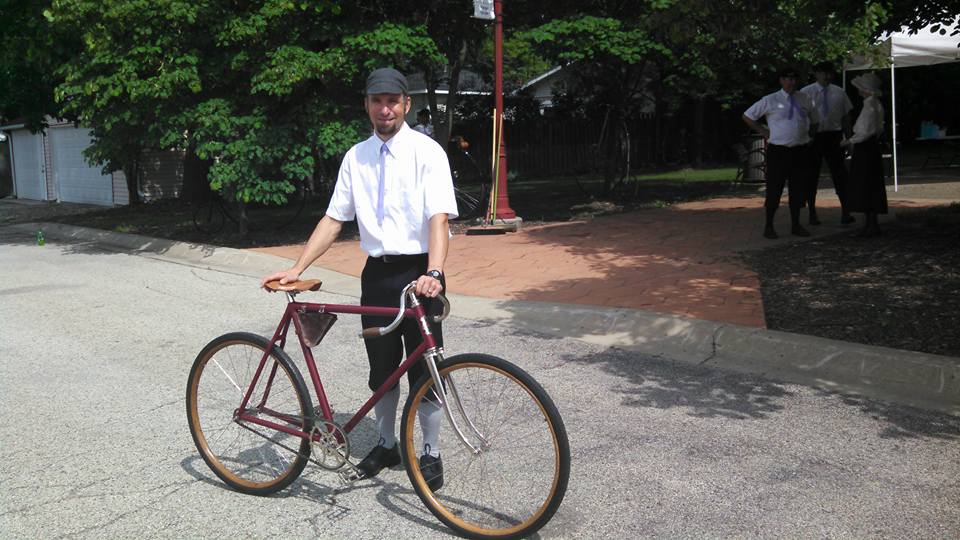
Christopher Sweet is a professor and Information Literacy and Scholarly Communications Librarian at Illinois Wesleyan University’s Ames Library.