
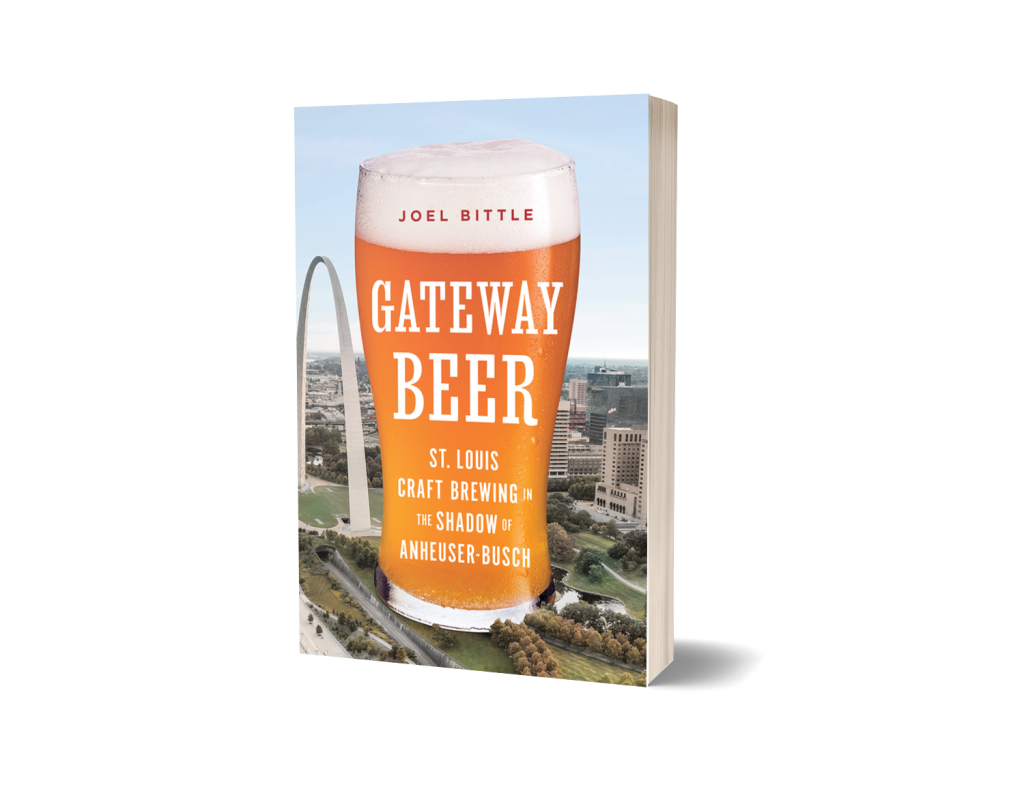
Joel Bittle, author of Gateway Beer: St. Louis Craft Brewing in the Shadow of Anheuser-Busch, answers questions about his new book.
Q: Why did you decide to write this book?
St. Louis history is tied to beer. Residents were devastated when Anheuser-Busch was sold to the international conglomerate InBev. What would the sale mean to a city that had already lost manufacturing jobs, lost their place as an airline hub with the sale of TWA, lost two NFL teams, and lost numerous fortune 500 companies? What followed was a beer renaissance in the form of a new and dynamic craft beer community, voted best in the country for three years in a row.
It was through conversations with craft brewers that I realized there were compelling stories within the greater story of beer in St. Louis. These scientists and artists took the best of what made St. Louis a beer city and created something new.
Q: What is the most interesting discovery you made while researching and writing your book?
Members of the St. Louis craft beer community lifted each other up. It was clear from the beginning that pitching a new kind of beer to a city raised on Budweiser was going to be tough. Instead of fighting over a small percentage of the beer market, craft brewers worked together to increase craft beer’s overall consumer awareness. It wasn’t them against each other; it was craft beer against big beer. Their belief was a rising tide lifted all boats. They shared hops and malt, fixed each others’ machinery, recommended interns for positions at breweries that had openings, and generally shared expertise.
Q: What myths do you hope your book will dispel or what do you hope your book will help readers unlearn?
That craft beer is dead or dying. The overall alcohol market has changed drastically over the past decade. The craft beer boom of the 2010s resulted in many breweries expanding quickly to distribute nationally, counting on continued growth. When growth slowed and distribution became saturated, those breweries found themselves too far in debt, and many closed. The model that survived – and continues to thrive – is neighborhood-based: supply the local neighborhood and limit distribution to a manageable radius. Food has become the draw as much as the beer, and breweries who collaborate with popular restaurants can feature both.
Q: Which part of the publishing process did you find the most interesting?
One of the brewers I wrote about was so pleased with my depiction of his brewery that he reached out to beer journalists to help me find a publisher. Several journalists led me to regional publishers who focused on books about the Midwest. One Chicago based publisher thought my book was perfect for the University of Illinois Press, who became a fantastic partner in getting this book published. I was struck by how each point of the publication journey was collaborative, like we were all in this together.
Q: What is your advice to scholars/authors who want to take on a similar project?
I would say to go all in on telling the story you want to tell. Don’t second guess whether it might be published. Worry about that afterwards. Before I began to work with the University of Illinois Press, another publisher wanted a stripped down version of my manuscript. Though that wasn’t what I was looking for, I knew I had that as a possibility to fall back on. Ultimately, two additional publishers responded with interest, which showed me I was right to stick to my goals.
Q: What do you like to read/watch/or listen to for fun?
Lately I have gone down the Rock & Roll biography rabbit hole, devouring books on The Beatles and the history of Folk, Glam, and Punk. Meet me in the Bathroom, the account of early 2000s New York music was a recent favorite of mine.

Joel Bittle is a freelance writer in St. Louis and a longtime part of the city’s craft beer community.