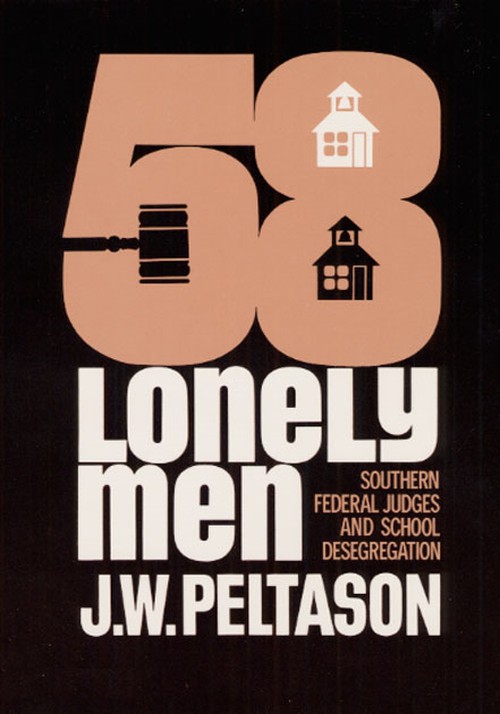
Fifty-Eight Lonely Men
About the Book
Originally published in 1961, this still timely book illustrates the role of the judiciary in the solution of a social and political problem. It is unequaled in its description of the plight of federal judges who are charged with carrying out the decisions of the Supreme Court against segregation but who are under constant pressure--social, political, and personal -- to speak for the white South. Some have been ostracized by their communities as traitors; others have joined their state legislatures and local school boards in developing elaborate delay strategy to circumvent the Supreme Court's decisions.
In his introduction to the first
edition former Senator Paul H. Douglas wrote: ". . . a clear and comprehensive
account of the legal struggles in the federal courts over segregation and desegregation
in the public schools of the nation. It gets behind the newspaper headlines
and gives a play-by-play account. . . . This book is indeed full proof of the
delays and difficulties of the law and the pressures of local public opinion."
About the Author
J. W. Peltason was president of the American Council on Education.Reviews
"The personalities of these 58 southern federal judges, the external pressures exerted on them, and their judicial decisions, are covered in great detail. The author includes in his discussion a brilliant analysis of the steps taken by segregationists to defeat the integration rulings of these courts."--Kirkus ReviewsBlurbs
"A clear and comprehensive account of the legal struggles in the federal courts over segregation and desegregation in the public schools of the nation. It gets behind the newspaper headlines and gives a play-by-play account. . . . This book is indeed full proof of the delays and difficulties of the law and the pressures of local public opinion."--Senator Paul H. Douglas, from the introduction
Related Titles