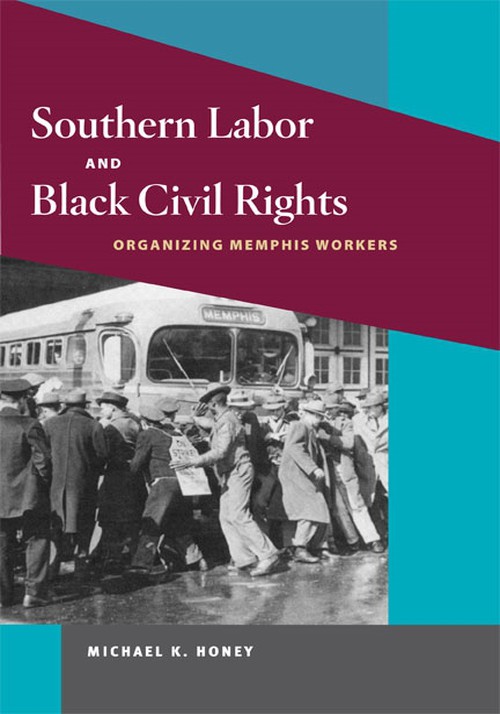
Southern Labor And Black Civil Rights
About the Book
Southern Labor and Black Civil Rights chronicles the rarely studied southern industrial union movement from the Great Depression to the cold war, using the strategically located river city of Memphis as a case study. Michael Honey analyzes the economic basis of segregation and the denial of fundamental human rights and civil liberties it entailed.Frequently telling his story through personal portraits of those directly involved, Honey documents the dramatic labor battles and sometimes heroic activities of organizers and ordinary workers that helped to set the stage for segregation's demise. His study of interracial industrial union organizing locates some of the roots of the 1960s civil rights struggles in this earlier era. Honey provides a new context for understanding Dr. Martin Luther King, Jr.'s 1968 campaign in support of poor people and black labor organizing in Memphis.
This detailed account provides a fresh perspective on African-American, labor, civil rights, and southern history. It clarifies the relationship between labor and civil rights struggles, deepens our understanding of the role of racism in blocking working-class advancement, and emphasizes the importance of southern interracial organizing to the history of social movements in the United States.
About the Author
Michael K. Honey is the Fred T. and Dorothy G. Haley Professor of the Humanities at the University of Washington Tacoma. His books include Going Down Jericho Road: The Memphis Strike, Martin Luther King's Last Campaign and the award-winning Black Workers Remember: An Oral History of Segregation, Unionism, and the Freedom Struggle.Reviews
"Packs the emotive power of a zillion 'race' memoirs precisely because it is the story of what happened when black and white workers collectively challenged the powers-that-be in the meanest city in the South."--Robin D. G. Kelley, The Nation"A vitally important contribution to the scholarly debate about the relationship between class and race in American history."--Bruce Nelson, Journal of American History
"Among the best and most ambitious recent works on labor in the South. . . . Few readers of this book are likely to remain unmoved by Honey's account of the exceptional sacrifice, courage, and vision displayed by labor activists in Memphis."--Georgia Historical Quarterly
"Sheds considerable light on numerous themes of importance to historians of a multiplicity of specialties, from labor and African American history, to historians of the South and twentieth-century America."--Labor History
"A well-researched and carefully written book. . . . Anyone interested in the Southern labor movement must consult this work."--Mississippi Quarterly
Blurbs
"A major contribution to the history of labor, race relations, and the twentieth-century South. . . . Honey vividly brings the labor movement to life and places Memphis in the wider context of southern and national history."--Pete Daniel, author of The Shadow of Slavery: Peonage in the South, 1901-1969
"A major new study of how the Solid South restrained social reform and labor's strength in New Deal America."--David Montgomery, author of The Fall of the House of Labor: The Workplace, the State, and American Labor Activism, 1865-1925
Awards
• Winner, Charles S. Sydnor Award -- (SHA), 1994• Winner, RAWLEY (JAMES A.) PRIZE--(OAH), 1994
• Winner, Herbert G. Gutman Prize for Outstanding Dissertation (LAWCHA), 1993
Related Titles