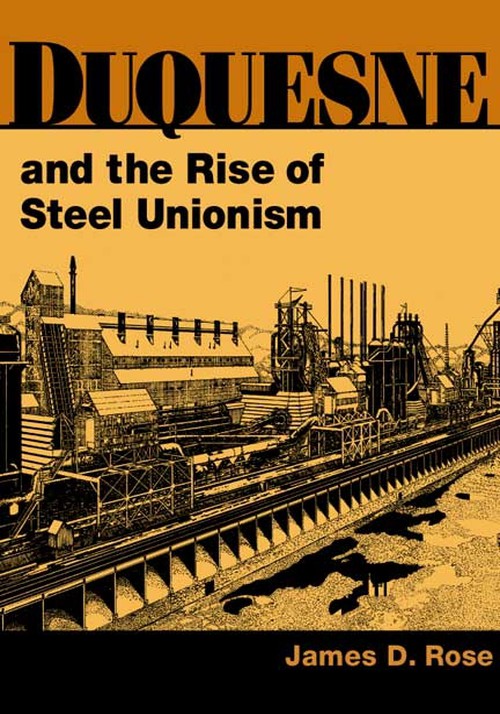
Duquesne and the Rise of Steel Unionism
About the Book
Not all workers' needs were served by the union. Focusing on the steel works at Duquesne, Pennsylvania, a linchpin of the old Carnegie Steel Company empire and then of U.S. Steel, James D. Rose demonstrates the pivotal role played by a nonunion form of employee representation usually dismissed as a flimsy front for management interests.The early New Deal set in motion two versions of workplace representation that battled for supremacy: company-sponsored employee representation plans (ERPs) and independent trade unionism. At Duquesne, the cause of the unskilled, hourly workers, mostly eastern and southern Europeans as well as blacks, was taken up by the union -- the Fort Dukane Lodge of the Amalgamated Association of Iron, Steel, and Tin Workers. For skilled tonnage workers and skilled tradesmen, mainly U.S.-born and of northern and western European extraction, ERPs offered a better solution.
Initially little more than a crude antiunion device, ERPs matured from tools of the company into semi-independent, worker-led organizations. Isolated from the union movement through the mid-1930s, ERP representatives and management nonetheless created a sophisticated bargaining structure that represented the shop-floor interests of the mill's skilled workforce. Meanwhile, the independent trade union gave way to the Steel Workers Organizing Committee, a professionalized and tightly organized that expended huge resources trying to gain companywide unionization. Even when the SWOC secured a collective bargaining agreement with U.S. Steel in 1937, however, the Union was still unable to sign up a majority of the workforce at Duquesne.
A sophisticated study of the forces that shaped and responded to workers' interests, Duquesne and the Rise of Steel Unionism confirms that what people did on the shop floor was as critical to the course of steel unionism as were corporate decision making and shifts in government policy.
Reviews
"An excellent book. Rose provides ample evidence for his arguments, and he challenges our conceptions of how industrial unionism took root in the United States. This book should be must reading for labor historians and industrial relations scholars."--James R. Zetka, Jr., Journal of American History
"Rose's study significantly expands our understanding of big steel and the rise of steel unionism in this country. . . . Rose's access to U.S. Steel's records . . . gives his account of the evolution of unionism in the steel industry a unique perspective. . . . His grasp of the historiography and nuances of the steel industry and unionism is both broad and deep."--Marilyn D. Rhinehart, American Historical Review
"Original and thought-provoking in its perspective, and clearly written. "--Kenneth Warren, Business History
"Rose delivers a well-crafted and detailed story which raises questions about working-class militancy and class consciousness in the decade many historians see as a high point of working-class mobilization and unity. And, he suggests, the Steelworkers Union adopted a highly-centralized and top-down organizational model not because union bureaucrats betrayed rank-and-file aspirations . . . but because workers were less united and less militant than supposed and because only a centralized and bureaucratic union could actually succeed. . . . Well worth reading."--Richard Oestreicher, Pennsylvania Magazine of History
"An excellent reference for serious students wanting specifics on the steel industry."--Tom Hull, Tech Directions
Related Titles