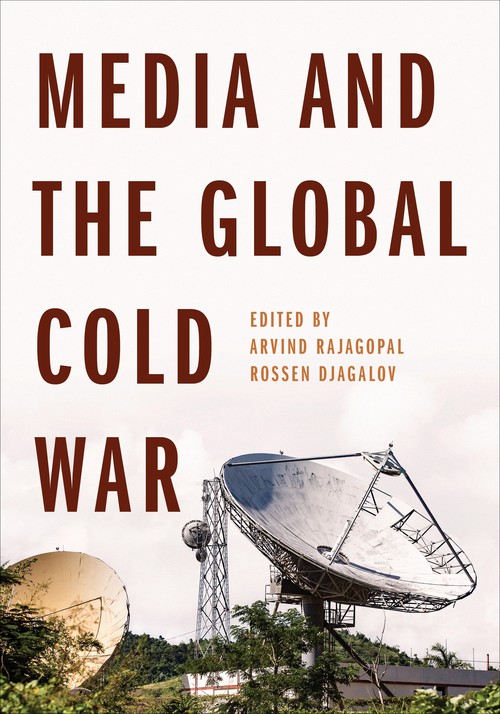
Media and the Global Cold War
New perspectives on a cornerstone of soft power during the Cold War and beyond
Cloth – $125
978-0-252-05993-3
Paper – $35
978-0-252-08979-4
eBook – $29.95
978-0-252-04935-4
Publication Date
Paperback: 01/12/2027
Cloth: 01/12/2027
Cloth: 01/12/2027
Series: The Geopolitics of Information
About the Book
In the Cold War era, media became a central force in the shaping of political life, cultural exchange, and ideas of global order. A rivalry between political systems expanded into a worldwide struggle over who could shape information, control communication infrastructures, and define reality.Arvind Rajagopal and Rossen Djagalov present essays on the uses of Cold War media. Focusing on the Global South, the contributors illuminate how postcolonial nations and others defied superpower pressure to use media for nation-building and international cooperation. At the same time, communication infrastructures linked global regions in unequal ways that often reinforced the power of the United States. Throughout, the essays show how Cold War media practices like secrecy, propaganda, and cultural diplomacy cemented patterns that still influence global communication systems and international politics today.
Cutting-edge and timely, Media and the Global Cold War reveals the workings of media beyond the superpower rivalry.
About the Author
Arvind Rajagopal is a professor of media studies at NYU and affiliated faculty in the Departments of Sociology and Social and Cultural Analysis. His books include The Indian Public Sphere: Structure and Transformation. Rossen Djagalov is an associate professor of Russian and Slavic Studies at NYU. He is the author of From Internationalism to Postcolonialism: Literature and Cinema between the Second and the Third World.Reviews
“Rajagopal and Djagalov have assembled something rare: a genuinely global account of how Cold War technopolitics built the communication infrastructures and cultural forms we still inhabit. This collection recovers erased histories with striking precision and real analytical ambition.”—Dwaipayan Banerjee, author of Computing in the Age of Decolonization: India’s Lost Technological Revolution
"A breakout study about the role of the media during the Cold War that puts dominant US-centric paradigms in the shade."
—Mrinalini Sinha, coeditor of Political Imaginaries in Twentieth Century India
Related Titles