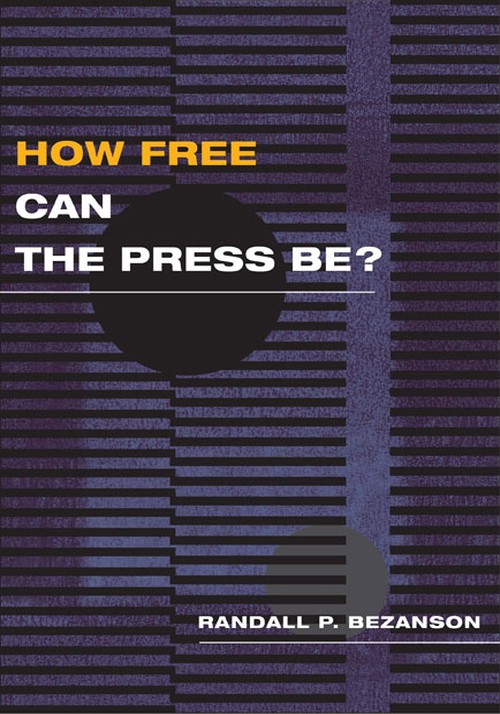
How Free Can the Press Be?
About the Book
The First Amendment to the Constitution states that Congress shall make no law abridging the freedom of the press, but the definitions of "press," of "freedom," and even of "abridgment" have evolved by means of judicial rulings on cases concerning the limits and purposes of press freedoms.In How Free Can the Press Be? Randall P. Bezanson explores the changes in understanding of press freedom in America by discussing in depth nine of the most pivotal and provocative First Amendment cases in U.S. judicial history. These cases were argued before the U.S. Supreme Court, state Supreme Courts, and even a local circuit court, and concerned matters ranging from The New York Times's publication of the Pentagon Papers to Hugo Zacchini, the human cannonball who claimed television broadcasts of his act threatened his livelihood. Other cases include a politician blackballed by the Miami Herald and prevented from responding in its pages, the Pittsburgh Press arguing it had the right to employ gender-based column headings in its classified ads section, and the victim of a crime suing the Des Moines Register over that paper's publication of intimate details, including the victim's name. Each case resulted in a ruling that refined or reshaped judicial definition of the limits of press freedom.
Does the First Amendment give the press a special position under the law? Is editorial judgment a cornerstone of the press? Does the press have a duty to publish truth and fact, to present both sides of a story, to respect the privacy of individuals, to obtain its information through legally acceptable means? How does press freedom weigh against national security? Bezanson addresses these and other questions, examining the arguments on both sides, and using these landmark cases as a springboard for a wider discussion of the meaning and limits of press freedom.
About the Author
Randall P. Bezanson was the David H. Vernon Professor of Law at the University of Iowa. His books include How Free Can Religion Be?Also by this author
Reviews
"Bezanson provides the kind of glimpses into the background of [court] cases that students love. . . . And he asks provocative questions at the end of each chapter which are virtually guaranteed to spark some lively debate in class about what the limits of press freedom ought to be."--Journalism & Mass Communication EducatorBlurbs
"This is an astonishing book. Bezanson approaches conventional cases in unconventional ways. Upon finishing it, one feels privileged to have participated in that rare seminar where the master professor leaves no position unchallenged."--Steven Helle, contributor to Last Rights: Revisiting Four Theories of the Press and numerous law journals, and Freedom Forum National Journalism Teacher of the Year
"Bezanson is one the country's leading First Amendment scholars. In this highly entertaining and well-researched book, he takes us into the gray area where freedom of speech and press collide with other rights and responsibilities. This is a must read for all journalists and for anyone concerned with limits on freedom of speech."--John Soloski, Dean, Grady College of Journalism and Mass Communication, University of Georgia
"Too often the press cries 'First Amendment' as if it gave an absolute answer--as if freedom of the press trumped all other values. Randall Bezanson has found an ingenious and fascinating way to cut through the absolutes, putting provocative questions about leading press cases that make us see that privacy, fairness, and other interests have their claim, too. Reporters, editors, and their lawyers should read this book and reflect on it."--Anthony Lewis, author of The Myth of the Imperial Judiciary: Why the Right Is Wrong About the Courts
Awards
• Commended, American Library Association -the Best of the Best from the University Presses, 2004Related Titles