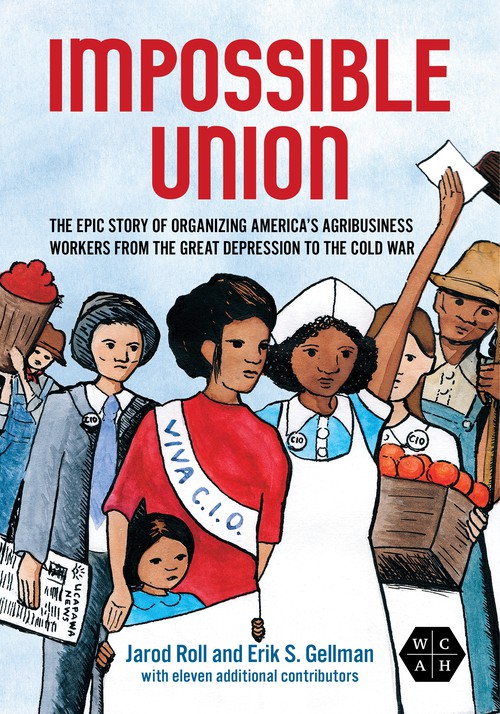
Impossible Union
The Epic Story of Organizing America's Agribusiness Workers from the Great Depression to the Cold War
The labor and civil rights accomplishments of the union that championed forgotten workers
Cloth – $135
978-0-252-08990-9
Paper – $38
978-0-252-08991-6
eBook – $29.95
978-0-252-08992-3
Publication Date
Paperback: 03/16/2027
Cloth: 03/16/2027
Cloth: 03/16/2027
About the Book
The United Cannery, Agricultural, Packing and Allied Workers of America (UCAPAWA), later renamed the Food, Tobacco, Agricultural and Allied Workers of America (FTA), organized some of the nation’s most exploited workers. Jarod Roll, Erik S. Gellman, and eleven other contributors provide a first-ever complete history of UCAPAWA-FTA that illuminates the union’s mission, accomplishments, and impediments while offering a new account of the potential for working-class democracy in the New Deal and World War II eras.Workers of many racial, ethnic, and social identities in the UCAPAWA-FTA. Their grassroots activism and bold national leadership fueled the union’s success despite opposition from employers, the government, and other labor groups. The union’s common-sense anti-fascism empowered workers to forge solidarities across vast differences and linked workers’ rights to campaigns against racism and inequality. UCAPAWA-FTA advocated for an inclusive democracy that can inform today’s struggles for dignity and security. This unique volume also includes a special collection of essays by affiliated scholars that explore specific aspects of the union’s larger history.
Expansive and monumental, Impossible Union chronicles the labor organization that brought personhood and power to America’s marginal yet essential workers.
Additional contributors: Benjamin Makani Fortun, Dorothy Fujita-Rony, Robert Korstad, Bernadette Pérez, Michael Pierce, Charles Romney, Vicki L. Ruiz, Dan Sidorick, Dwana Waugh, John Weber, and Lane Windham
About the Author
Jarod Roll is the Kinder Institute Professor of Missouri History & Constitutional Democracy at the University of Missouri. He is the author of Poor Man’s Fortune: White Working-Class Conservatism in American Metal Mining, 1850-1950. Erik S. Gellman is a professor of history at the University of North Carolina at Chapel Hill. He is the author of Troublemakers: Chicago Freedom Struggles through the Lens of Art Shay. Roll and Gellman coauthored The Gospel of the Working Class: Labor's Southern Prophets in New Deal America.Reviews
“In the heart of the Great Depression, the poorest workers in America created a labor union that successfully fought on behalf of justice for all. Their story is beautifully depicted in Impossible Union. Indispensable lessons for labor organizers and scholars today.”—Paul Ortiz, author of An African American and Latinx History of the United States
“Jarod Roll and Erik Gellman have a remarkable story to tell. It is about the UCAPAWA, a scrappy and not widely known union that organized the lowest of lowest paid laborers in the United States, the multi-racial collections of people who harvested, packed, and processed the nation’s food and agricultural commodities. This ‘impossible union’ fought for better pay, safer conditions on the job, days off, and sick leave, while insisting that employers respect their basic rights and dignity on the job and in their communities. Their triumphs will make you jump out of your seat; their losses will break your heart.”
—Bryant Simon, author of The Hamlet Fire: A Tragic Story of Cheap Food, Cheap Government, and Cheap Lives
“Impossible Union does the impossible itself in providing a detailed account, te first of its kind in scope, of the history of the multi-site, multifaceted Food, Tobacco, Agricultural and Allied Workers (FTA) union through some of the most tumultuous decades of twentieth century US history. The book is an amazing accomplishment based on an incomparable amount of research undertaken, all woven together into a richly told, riveting, narrative. I didn’t want to put it down.”
—Lisa Phillips, author of A Renegade Union: Interracial Organizing and Labor Radicalism
“A monumental achievement. Gellman and Roll have combed archival collections and followed UCAPAWA-FTA’s trail from coast to coast to tell a comprehensive history of an important union from the 10,000-foot view. Their book recovers the story of UCAPAWA-FTA’s expansive and multiracial vision of American democracy while also taking seriously the productive tensions and organizing traditions within the union and among its staff. The authors successfully embrace institutional history while not losing sight of the rank-and-file.”
—Jessie Wilkerson, author of To Live Here, You Have to Fight: How Women Led Appalachian Movements for Social Justice
Related Titles