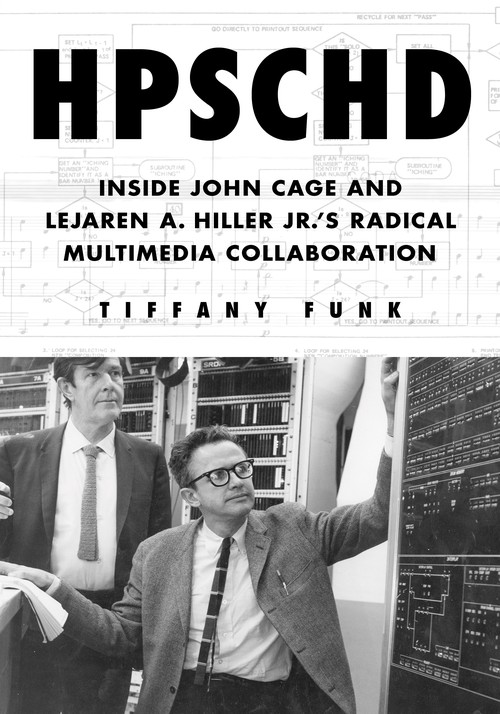
HPSCHD
Inside John Cage and Lejaren A. Hiller Jr.'s Radical Multimedia Collaboration
A historic collision of music, machines, and audience
Cloth – $110
978-0-252-05995-7
Paper – $32
978-0-252-08980-0
eBook – $29.95
978-0-252-04937-8
Publication Date
Paperback: 03/02/2027
Series: Music in American Life
About the Book
In 1969, John Cage and Lejaren Hiller presented a multimedia performance that expanded the possibilities of what music and art could be. Harpsichords, computer-created tapes, films, and slides surrounded thousands of audience members while a fusion of randomness with technology gave each attendee their own unrepeatable experience.Tiffany Funk explores how HPSCHD’s use of early computer art helped change ideas about sound, chance, and authorship. The event was less a concert than a performative system built through programming, labor, and shared decision-making. Computer art of the era required physical labor and collaboration. The impact of everything from punch cards to magnetic tape shaped the work while revealing the human effort involved. Throughout, Funk reveals that HPSCHD still offers valuable lessons about machines as collaborators rather than tools; the politics of technology; and the tension between the excitement and fears of automation.
An in-depth look at an avant-garde landmark, HPSCHD takes readers inside a legendary merger of music with computer art and its ongoing relevance in today’s digital world.
*
Publication has been made possible, in part, by funding provided by the AMS 75 PAYS Fund of the American Musicological Society and by a grant from the Henry and Edna Binkele Classical Music Fund.
About the Author
Tiffany Funk is a visiting assistant professor in the School of Art at the University of Illinois Chicago and the director of publications for the Video Game Art Gallery.Reviews
“On May 16, 1969, nearly six thousand people packed the University of Illinois’s Assembly Hall for HPSCHD, a five-hour spectacle run on the university’s own ILLIAC supercomputers. Tiffany Funk’s book is the first to give this landmark event, and the institution behind it, its full due. Her central insight is that HPSCHD was a genuine collaboration between the composer, John Cage, and Lejaren Hiller, a computer engineer who insisted ‘every single note was a mutual decision, you can’t tell them apart.’ They meant it, and Funk treats their mainframe experimentalism as a model for theorizing authorship newly urgent in an age of generative AI. This is a story about Illinois’s deep, formative role in the history of computer art, a role too often ceded in the popular imagination to coastal labs and corporate research centers. Funk makes a compelling case that the university’s investment in computational research produced not just scientific advances but an artistic landmark, whose influence (visible decades later at the university’s Electronic Visualization Lab and far beyond) continues to ripple outward. Piecing together archives that survived a string of campus arsons, Funk reconstructs the experience, sonic, visual, bodily, of Assembly Hall that night, and reclaims Illinois’s place in American technological, cultural, and intellectual history.”—Hannah B Higgins, coeditor of Mainframe Experimentalism: Early Computing and the Foundations of the Digital Arts
Related Titles