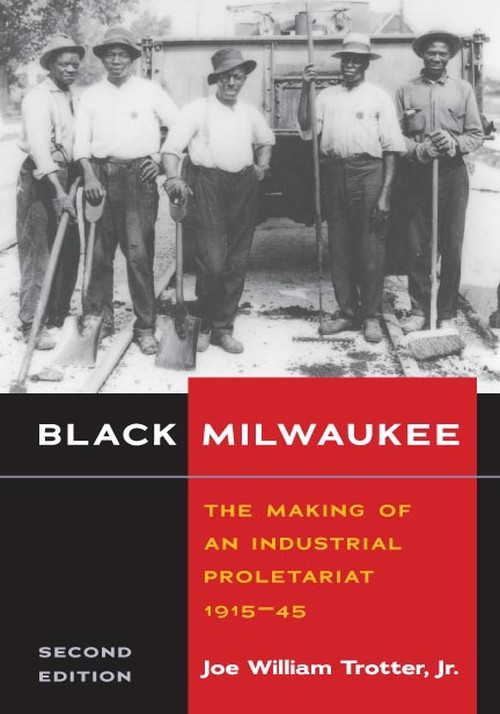
Black Milwaukee
The Making of an Industrial Proletariat, 1915-45Second Edition
The classic of Black workers in a Midwestern city
eBook – $33
978-0-252-04946-0
Publication Date
About the Book
A groundbreaking study, Joe William Trotter Jr.’s Black Milwaukee provides a detailed account of Black Milwaukeeans that goes beyond the ghetto experience to look at their lives as industrial workers. Trotter illuminates how the Black laborers undertook a hard and lengthy process to achieve recognition as blue collar workers. This edition features the author’s essay on African American urban history since 1985; a prologue on the antebellum and Civil War roots of Milwaukee’s Black community; and an epilogue that covers the post-World War II years and the era of deindustrialization. Brief essays by William P. Jones, Earl Lewis, Alison Isenberg, and Kimberly L. Phillips assess the book’s impact on the study of Black urban history since its original publication.About the Author
Joe William Trotter Jr. is the Giant Eagle University Professor of History and Social Justice at Carnegie Mellon University and the director and founder of Center for Africanamerican Urban Studies & the Economy. He is the author of Workers on Arrival: Black Labor in the Making of America and coeditor of The Ghetto in Global History: 1500 to the Present.Reviews
“Trotter has written a valuable, provocative book that opens new areas for certain—and heated—debate.”—Arnold R. Hirsch, Journal of American Ethnic History
“This highly readable book is a classic, and rightly so, in the interconnected areas of labor, Black, and urban history.”
—Labor Studies Journal
"Trotter blazed new ground, courageously argued his thesis despite the skeptical eyes of non-Marxists, seamlessly connected local, urban, black, and labor history, and skillfully recounted the ways that black Milwaukeeans forged their own lives. The second edition is well worth reading."
—H-Urban
"Thanks to its original methodology, outstanding research and meticulous attention to detail Black Milwaukee has become a seminal work in labour history."
—Left History
“This highly readable book is a classic, and rightly so, in the interconnected areas of labor, black, and urban history.
—Labor Studies Journal
Praise for the first edition:
“Trotter has written a valuable, provocative book that opens new areas for certain--and heated--debate.”
—Journal of American Ethnic History
Related Titles