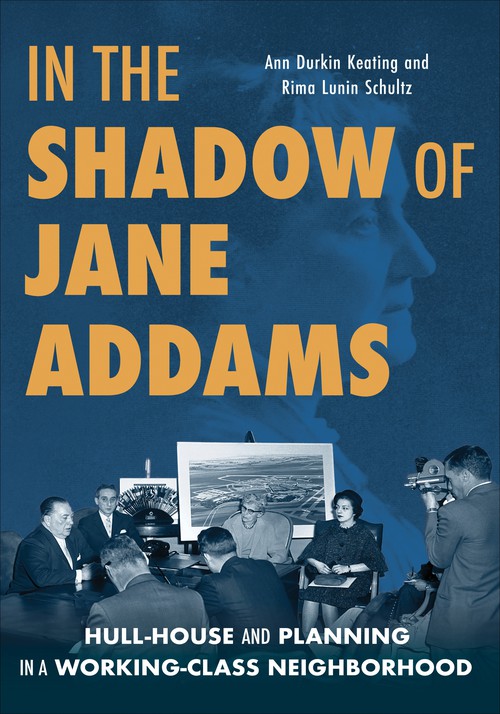
In the Shadow of Jane Addams
Hull-House and Planning in a Working-Class Neighborhood
Planners, residents, and the fate of Chicago’s Near West Side
Cloth – $110
979-8-240-40025-4
Paper – $27.95
979-8-240-40026-1
eBook – $24.95
979-8-240-40027-8
Publication Date
Paperback: 04/13/2027
About the Book
The neighborhood around Hull-House on Chicago’s Near West Side was a laboratory for the settlement movement and reformers dedicated to improving working-class neighborhoods. Ann Durkin Keating and Rima Lunin Schultz explore the Near West Side neighborhood through ideas to improve, maintain, and remake it.The authors focus on five plans proposed between 1889 and 1961 by Hull-House, the US government, the Chicago Plan Commission, residents, and finally the 1961 University of Illinois plan that destroyed the existing neighborhood. Proposals often expected residents to leave while eliminating the diversity of people, industries, and businesses in favor of the homogeneity favored by the middle and upper classes. At the same time, other plans tried but failed to improve the Near West Side’s inadequate housing, environmental conditions, and poor access to social services. Keating and Schultz also show how the definition of urban planning changed over time and how it impacted ideas for the neighborhood.
Detailed and perceptive, In the Shadow of Jane Addams explores how power, policy, and local voices shaped urban neighborhoods in Chicago and across the United States.
About the Author
Ann Durkin Keating is Dr. C. Frederick Toenniges Professor Emeritus of History at North Central College. Her books include The World of Juliette Kinzie: Chicago before the Fire and Rising Up from Indian Country: The Battle of Fort Dearborn and the Birth of Chicago. Rima Lunin Schultz is an independent scholar and coeditor of Women Building Chicago 1790–1990: A Biographical Dictionary.Reviews
“In the Shadow of Jane Addams is remarkable for following the diverse, working-class neighborhood of Chicago’s Near West Side over many decades, as it was subjected time and again to efforts by reformers and planners to implement visions of community improvement. This history, filled with unintended consequences and failures despite even the best of intentions, carries crucial lessons for cities today.”—Lizabeth Cohen, author of Saving America’s Cities: Ed Logue and the Struggle to Renew Urban America in the Suburban Age
Related Titles