"We, Too, Are Americans"
About the Book
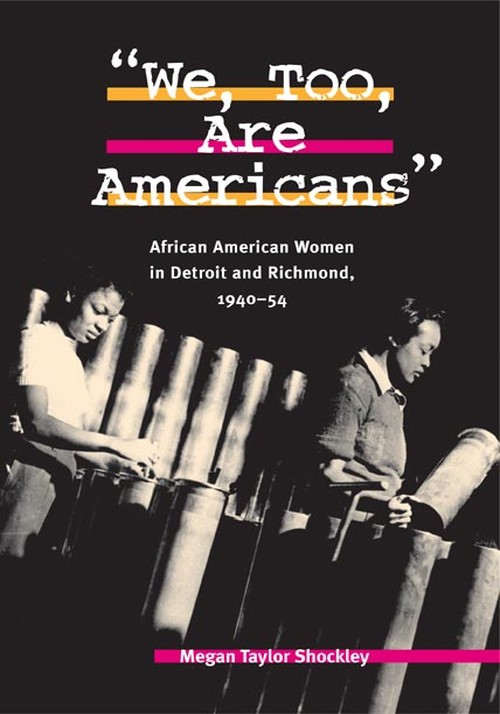
During World War II, factories across America retooled for wartime production, and unprecedented labor opportunities opened up for women and minorities. In We, Too, Are Americans, Megan Taylor Shockley examines the experiences of the African American women who worked in two capitals of industry--Detroit, Michigan, and Richmond, Virginia--during the war and the decade that followed it, making a compelling case for viewing World War II as the crucible of the civil rights movement.As demands on them intensified, the women working to provide American troops with clothing, medical supplies, and other services became increasingly aware of their key role in the war effort. A considerable number of the African Americans among them began to use their indispensability to leverage demands for equal employment, welfare and citizenship benefits, fair treatment, good working conditions, and other considerations previously denied them.
Shockley shows that as these women strove to redefine citizenship, backing up their claims to equality with lawsuits, sit-ins, and other forms of activism, they were forging tools that civil rights activists would continue to use in the years to come.
About the Author
Megan Taylor-Shockley is a professor of history at Clemson University. She is the author of The Captain's Widow of Sandwich: Self-Invention and the Life of Hannah Rebecca Burgess, 1834-1917.Reviews
"An excellent, long overdue look into African American women's resistance to racist employers, domestic work, racist/gender stereotypes, moderate civil rights organizations, and bureaucratic state agencies."--Labor Studies Journal"Shockley amply demonstrates that African American women, regardless of class, together contributed a profound sense of miltancy and urgency to the emerging civil rights movement."--Journal of Southern History
"Recognizes women in World War II and the early Cold War for their participation in civil rights actions and their expansion of the themes of democracy and a 'Double Victory' for rights at home and abroad, , , , A valuable resource for the interpretation of civil rights in this period [and] supports the view that this period was most important as an attitudinal crucible of the civil rights movement."--Journal of American History
Blurbs
"Fascinating, well-written, and convincing, Shockley's impressive study fills a significant gap in the historical literature."--Gretchen Lemke-Santangelo, author of Abiding Courage: African American Migrant Women in the East Bay Community
Related Titles