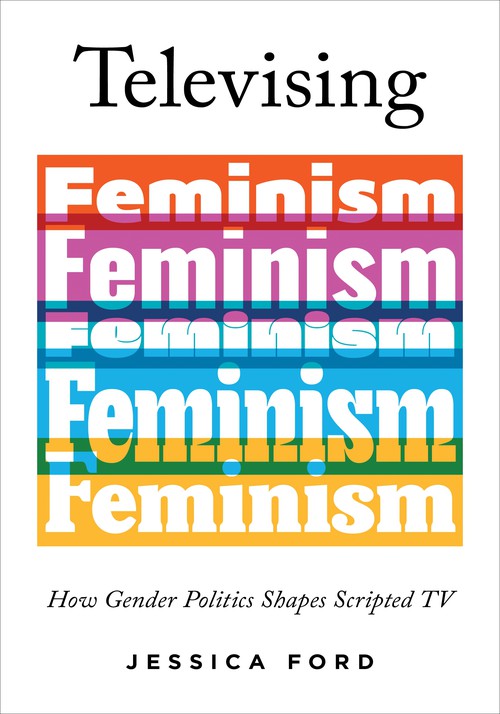
Televising Feminism
How Gender Politics Shapes Scripted TV
Twenty-first-century television’s many complex and contradictory feminisms
Cloth – $110
978-0-252-05990-2
Paper – $27.95
978-0-252-08977-0
eBook – $24.95
978-0-252-04932-3
Publication Date
Paperback: 11/17/2026
Series: Feminist Media Studies
About the Book
Starting in the 2010s, women played an increasingly prominent and complex role in the scripted television landscape of the United States. But did TV become more feminist in content and form? Or did the shows just seem more feminist because women took up more prominent positions?Jessica Ford examines popular media’s tendency to apply the feminist label to all women-centric TV. Focusing on the post-Sex and the City era that began in 2005, Ford explores how women-centric scripted TV absorbed the feminisms of its past. It now televises these feminisms in divergent, diffuse, and distinct ways that find expression as a sensibility rather than a cogent politic, genre, or category. Ford’s analysis examines shows identified as feminist alongside programs that negotiate ideas, offer critiques, generate feelings and sentiments, and deploy aesthetics in both low-key and visible political ways.
Innovative and insightful, Televising Feminism looks at the construction and expression of the many feminisms at work on American scripted television.
About the Author
Jessica Ford is a senior lecturer in media at Adelaide University, Australia.Reviews
“In Televising Feminism, Jessica Ford argues that feminism on contemporary television is not defined by content, authorship, or genre, but by sensibility. She examines the complex and often contradictory ways women-centered US scripted TV absorbs, reshapes, and contests feminist ideas and politics. Passionate and lucid, this is a smart, compelling book that redefines how we think about feminist television.”—Tanya Horeck, author of Public Rape: Representing Violation in Fiction and Film
“Ford’s innovative approach brings together journalistic and academic analysis to understand US TV’s feminist sensibility. Her fluid, engaging style and wide-ranging content make for an excellent teaching tool for anyone trying to figure out exactly what is feminist about feminist TV.”
—Jorie Lagerwey, coauthor of Horrible White People: Gender, Genre, and Television's Precarious Whiteness
Related Titles