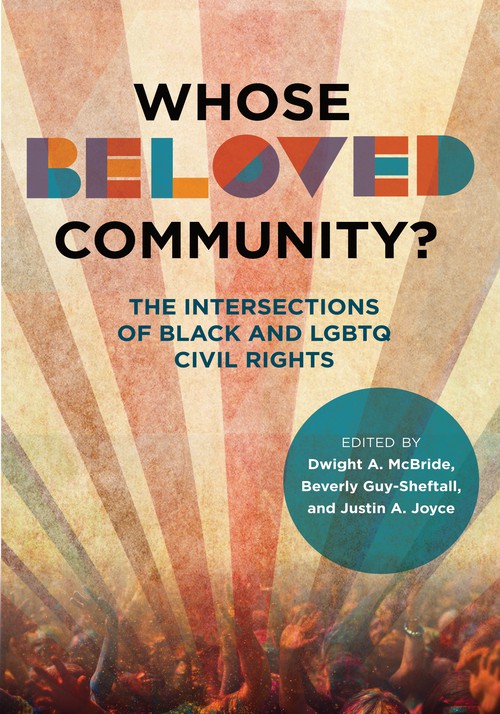
Whose Beloved Community?
The Intersections of Black and LGBTQ Civil Rights
A roadmap toward inclusion and justice
Cloth – $125
978-0-252-04942-2
Paper – $29.95
978-0-252-08985-5
eBook – $24.95
978-0-252-04943-9
Publication Date
Paperback: 10/27/2026
Series: The New Black Studies Series
About the Book
Martin Luther King Jr.’s idea of “the beloved community” focused on the hoped-for new relationship between the oppressor and the oppressed after the success of a nonviolent movement. But the vision excluded, and sometimes still excludes, LGBTQIA+ people and Black women.The editors curate essays that see beloved community as a generative space that centers justice. Taking inspiration from the radical moral vision of figures like Bayard Rustin and Audre Lorde, the contributors look at how Black queer, feminist, and trans thought and practice can cultivate belonging across lines of race, gender, sexuality, class, and region. Essayists use a variety of disciplinary and methodological perspectives that includes archival recovery, institutional critique, cultural analysis, ethnography, and political theory. The contributors define beloved community for themselves while offering entry points—through art, culture, activism, policy, pedagogy, and theory—for exploring what it means to belong, to resist, and to build.
Expansive and interdisciplinary, Whose Beloved Community? begins the process of advancing toward truly inclusive communities that are more honest, more complex, and more loving.
About the Author
Dwight A. McBride is the Gerald Early Distinguished Professor of African & African American Studies at Washington University in St. Louis. Beverly Guy-Sheftall is the Anna Julia Cooper Professor of Women’s Studies at Spelman College. Justin A. Joyce is founding co-editor and the managing editor of James Baldwin Review and a senior publications editor at Washington University in St. Louis.Reviews
“This volume extends Dr. King's notion of the beloved community to address some of the most pressing issues around race, gender, and sexuality, and in doing so it takes that notion to domains that even the civil rights icons could not imagine.”—Roderick A. Ferguson, author of We Demand: The University and Student Protests
Related Titles