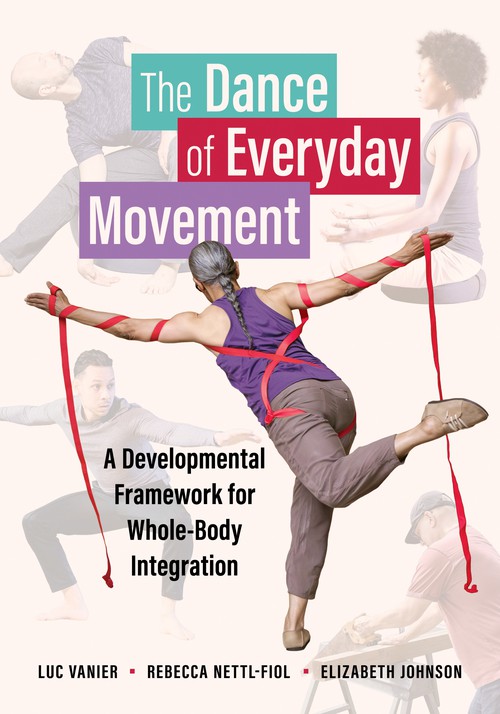
The Dance of Everyday Movement
About the Book
Everyone can have their own movement practice. Building on Dance and the Alexander Technique, Luc Vanier, Rebecca Nettl-Fiol, and Elizabeth Johnson present an innovative method for observing and analyzing movement in daily life, the performing arts, and therapeutic contexts.The authors’ Framework for Integration is a multifaceted approach to understanding and refining human movement. Core principles—such as psychophysical unity, developmental movement, and attention to breath—reveal how small changes in awareness and intent transform activities ranging from yoga and Tai Chi to sitting meditation, from gardening and sports to playing a musical instrument. Real-world applications highlight how individuals of all abilities and ages can reduce pain, improve coordination, and discover more efficient, joyful movement. Guest contributors detail how these concepts enhance artistic expression, interventions for trauma or chronic pain, and everyday tasks like driving and housework.
Engaging and aimed at non-specialists, The Dance of Everyday Movement invites practitioners from all walks of life to embrace ongoing development, resilience, and a more embodied way of living.
About the Author
Luc Vanier is the founding director of the University of Utah School of Dance and coauthor of Dance and the Alexander Technique: Exploring the Missing Link. Rebecca Nettl-Fiol is a professor of dance at the University of Illinois at Urbana-Champaign and coauthor of Dance and the Alexander Technique: Exploring the Missing Link. Elizabeth Johnson is an associate professor and chair of the Department of Dance at the University of Maryland, Baltimore County.Reviews
“The Dance of Everyday Movement is a powerful integration of science and Somatics, and reveals how small shifts in awareness can transform movement, reduce pain, and bring greater ease and joy to everyday life.”—Eric Franklin, author of Dynamic Alignment through Imagery
“This book is a fascinating and groundbreaking guide to movement re-education. It offers systematic and clearly articulated explorations for identifying and modifying one’s habitual movement patterns to find improved function, better health and more satisfaction in being alive.”
—Bill Evans, founder of the Somatic Dance Conference and Performance Festival
Supplemental Material
Supplementary Materials: Audio, Video, and Photographs
Foreword
Chapter 2
Chapter 4
Movement Explorations
4.6 Ballroom Walking Forward and Back with Your Hands Touching and Your Back in Primary
Extra Video
Chapter 5
Movement Explorations
5.4 Rolling from the Back to the Front
5.10 Mapping the Spirals of the Trunk
5.13 Double Spirals of Arms - Upper Against Lower, Both Ways
5.14 Hip to Fingers Spiral Pathway
5.16 Spiral from Sitting with Legs in Front
Extra Videos
Chapter 6
Movement Explorations
6.3 The Resilience of the Structure
6.5 Spiral Roll - Even and Organic Phrasing
Chapter 8
Movement Explorations
8.1 Primary Control Illustration Lying Prone
8.2 Rocking Back and Forth on All Fours
8.4 Crawling on All Fours Revisited: Upper and Lower Triangles
Chapter 9
Movement Explorations
9.1 Primary Ball Forward (Beach Chair) with partner
9.1 Primary Ball Back (Sandals) with partner
9.2 Squatting Revisited with Triangle Animation
9.3 Baby in Squat Doing Lateral Shifts
9.3 Spirals in Transferring Weight While Standing
Extra Videos
Chapter 14
Applications
Getting in and out of a Car with Spirals
Chapter 16
Application for Musicians
Coordination Underlying Musical Intention at the Harp, Part 1
Coordination Underlying Musical Intention at the Harp, Part 2
Coordination Underlying Musical Intention at the Harp, Part 3
Coordination Underlying Musical Intention at the Harp, Part 4
Coordination Underlying Musical Intention at the Harp, Part 5
Coordination Underlying Musical Intention at the Harp, Part 6
Coordination Underlying Musical Intention at the Harp, Part 7
Coordination Underlying Musical Intention at the Harp, Part 8
Coordination Underlying Musical Intention at the Harp, Part 9
Coordination Underlying Musical Intention at the Harp, Part 10
Coordination Underlying Musical Intention at the Harp, Part 11
Coordination Underlying Musical Intention at the Harp - Synthesis plus Performance
Movement Explorations
16.1 Weight Transfer, Simple Spiral, Counter Spiral
16.2 Weight Transfer with the Violin
16.4 Figure Eight with the Violin
Extra Video
Related Titles